Friday, January 11, 2013

Opening of the Ed L. Jenkins Papers

The Russell Library is proud to announce the opening of the Ed L. Jenkins Papers.

Ed Jenkins with Georgia's Peanut Princess, 1980.
Ed L. Jenkins Papers, Russell Library.
Edgar “Ed” L. Jenkins of Jasper, GA served as a Democratic member of the House of Representatives from 1977 until 1992.  Jenkins started out as a country trial lawyer in Jasper, GA before entering the political arena. He first cut his teeth on the political sphere working as an assistant for fellow Jasper resident, Representative Phil Landrum, from 1959 to 1962. After returning to his country law practice, Jenkins was elected to the 95th Congress in 1976.

As the representative for Northwest Georgia, Jenkins worked tirelessly on behalf of the needs of his constituents – in particular, Jenkins was a strong advocate for the textile industry. He was involved in several committees and caucuses including service as chairman for the Congressional Textile Caucus and was a member on the House Ways & Means Committee where he was active on its Trade Subcommittee. It was during his tenure on the Trade Subcommittee that Jenkins sponsored the Textile and Apparel Trade Enforcement Act of 1985 -which is often referred to as the “Jenkins amendment”. The amendment proposed limiting the amount of textile imports allowed from major producing countries outside the US. Although the amendment was ultimately vetoed by the President and failed to pass in the House, the number of co-sponsors for the bill and quantity of files on the amendment found in his collection demonstrates his tenacity for supporting domestic production in the United States, and in particular for the textile industry in Georgia. 

Ed Jenkins speaking about the Textile & Trade Enforcement Act
at a press conference, 1985. Ed L. Jenkins Papers, Russell Library.
When he wasn’t fighting on behalf of the textile industry, Jenkins also worked to support conservation and recreation efforts for the Chattahoochee National Forest, on tax legislation, was involved in the development of President Reagan’s Balanced Budget amendment.


In 1987, Congressman Jenkins became a familiar face on television when he was appointed to the House Select Committee during the Iran-Contra Hearings.  Jenkins' quiet and assuming manner and approach to interrogating Col. Oliver North was well-noted by not only his constituents in Georgia, but the wider American public.

Jenkins chose not to run for another term after the 102nd Congress in 1992. Following his retirement from politics, Jenkins returned to Georgia where he remained actives in church and civic affairs and served as Chairman of the Board of Regents for the University System of Georgia. On January 1, 2012, Jenkins passed away shortly before his 79th birthday.

The opening of the Ed L. Jenkins papers on the 20th anniversary of his retirement from Congress is a celebration of a Georgia politician who was once described as “one of the smart operators on Capitol Hill.”

The Richard B. Russell Library for Political Research and Studies is open for research Monday through Friday from 8:30am to 4:30pm, with the exception of University holidays. For more information, please visit http://www.libs.uga.edu/russell/ or call (706) 542-5788.

Posted by Tammi Kim, Processing Assistant for Arrangement & Description Unit, Russell Library

Wednesday, January 09, 2013

Call for Volunteers!

The University of Georgia’s Richard B. Russell Building Special Collections Libraries is now accepting applications for participants in its docent program. 

The Docent Corps is a skilled group of volunteers who provide tours of the library galleries to visitors, ranging from fifth graders to adults. Docents are trained to highlight permanent and rotating exhibitions and to help increase awareness of the many resources offered by the three special collections libraries: the Hargrett Rare Book and Manuscript Library, the Walter J. Brown Media Archive and Peabody Awards Collections and the Richard B. Russell Library for Political Research and Studies

“Participation in the docent program requires a substantial commitment of time and energy on the part of volunteers, but we think it is tremendously rewarding,” said Jan Levinson, outreach archivist with the Russell Library for Political Research and Studies, who coordinates the program. 

A 10-week training program provides an opportunity for docents to meet curators, archivists and other special collections staff; learn about the collections and techniques for leading tours; and become familiar with all parts of the Russell Special Collections Building. Follow-up meetings throughout the year provide opportunities to learn about new exhibits in the galleries and programs sponsored by the three special collections libraries. 

“We are looking for applicants who are enthusiastic, flexible and open to working with visitors of all ages,” Levinson said. “We don’t require prior experience in the arts and humanities, but a love of history and experience with teaching or public speaking is desirable.” 

For more information about the docent program, see http://www.libs.uga.edu/scl/contribute/volunteer.html. For more information about the training schedule and expectations, see http://www.libs.uga.edu/scl/contribute/docent_training_overview_faq_spring13.pdf

Interested individuals can apply online at http://www.libs.uga.edu/scl/contribute/docentapp.html. Applications must be submitted by Feb. 8, 2013. Questions may be directed to Jan Levinson at jlevinso@uga.edu or 706/542-5788. All candidates selected for admission to the docent program will be required to submit to a background investigation.

Friday, January 04, 2013

Hugh Gillis: Georgia's Longest Serving Lawmaker

At the time of his retirement in 2004, Hugh Gillis was the longest serving member of the Georgia General Assembly. He passed away on New Year's Day 2013 at the age of 94.

Gillis was born in Soperton, Georgia on September 6, 1918. He was the grandson of Treutlen County founder and state representative Neil Gillis, the son of state senator and highway commissioner Jim L. Gillis, and brother of Jim L. Gillis, Jr. Gillis attended Georgia Military College, and in 1939 received an undergraduate degree in agriculture from the University of Georgia.

In 1941, he ran successfully for the Georgia House of Representatives. He served two terms, one from 1941 to 1944, and the other from 1949 to 1956. Meanwhile, he started his own company, Gillis Ag and Timber. Gillis was elected twice to the Georgia Senate, the first time in 1957, and the second in 1962. He would hold that seat for the next forty-two years, making him the longest-serving member of the Georgia General Assembly. In the senate, he was elected president pro tempore, and served on the Appropriations Committee. Working to bring doctors to rural communities, Gillis was influential in the creation of the dental school at the Medical College of Georgia in Augusta. He also served as head of the Natural Resources Committee, a seat which he held until his retirement in 2004.

In 2008, Bob Short interviewed Gillis for the Russell Library's Reflections on Georgia Politics oral history series. 


Thursday, January 03, 2013

When the World Tuned In to Watch...

When I began processing the Ed L. Jenkins Papers, I was excited to see that his collection included some papers related to the Iran-Contra Hearings. In 1987, in between advocating for trade and budget legislation, Jenkins found himself appointed to the House Select Committee to Investigate Covert Arms Transactions with Iran. Along with the Senate Select Committee on Secret Military Assistance to Iran and the Nicaraguan Opposition, the televised hearings became known as the Iran-Contra Hearings. The hearings marked the first time that joint hearings were held by the House and Senate.

On May 5, 1987, the world tuned in to watch the first of 41 days of the televised joint hearings that made political figures such as Lieutenant Colonel Oliver North, Vice Admiral John Poindexter, Senator Daniel Inouye, Senator Warren Rudman, and Representative Ed Jenkins household names.

The files related to the hearings in the collection range from exhibits and committee memorandum to  reports and testimonies. What I found most interesting in the files was the volume of constituent letters and telephone messages responding to the hearings, all maintained by Jenkins' constituent services staff.

In July 1987, Lt. Col. Oliver North began his week-long testimony before the joint committee. It was during the North testimony that Jenkins took center stage to question the National Security Council staff member about his involvement with the armed sales transaction to Iran. Constituent responses in the letters and telephone messages sent to the Congressman’s office range from outrage over the “lynch-mob” style of the hearings to praise over Jenkins’ calm and effective ability to question Lt. Col. North and other witnesses in the hearings.  And while the majority of the constituent responses praise Jenkins, others responded in indignation over the words and actions of other members of the joint committee.

Regardless of who or what was “right” or “wrong” in the political sphere, reading the responses by the public (the good, the bad, and the ugly) demonstrates the continuing importance of constituents expressing their opinions to their elected officials.


Post by Tammi Kim, Processing Archivist, Russell Library


Tuesday, December 11, 2012

First Person Project Celebrates Stories of Love

Do you remember the first time you fell in love?

This February the First Person Project, an oral history series documenting the experiences of everyday Georgians, invites participants to tackle the topic of love. How did you meet your spouse? What do you remember about your worst breakup or most awkward date? Find an interview partner and join us to record stories about love, loss, and relationships in celebration of Valentine’s Day.  

Six sets of partners will be accepted for this First Person Project session, scheduled for Friday, February 8th between 9:00am and 4:00pm. Each audio recording session takes one hour to complete. Photographs will also be taken for each session. The Russell Library will archive the interviews to add to its documentation of life in post 20th century Georgia and will provide participants with a free digital download of the recording and photographs. Participants are charged a fee of $10 per group for the session.

If you have a friend or family member with a story to tell, become a part of the First Person Project. Reservations are on a first come first serve basis and can be made by calling 706-542-5788 or registering online at http://www.libs.uga.edu/russell/fpp/fpp_register.html.

For more information on this event and other upcoming First Person Project days, please email russlib@uga.edu or call (706) 542-5788.

More About the First Person Project

Modeled roughly on StoryCorps, a national initiative partnered with National Public Radio and the Library of Congress, the First Person Project is smaller in scale but similar in concept, providing tools to would-be oral history interviewers and interviewees, including tips on how to create questions and conduct interviews. The project was inspired by the belief that everyone is an eyewitness to history, and that everyone, sometimes with a little encouragement, has a story to tell.

Free event parking available in the Hull Street Parking Deck. For more information visit:
http://www.libs.uga.edu/scl/visit/parking.html  

To learn more about the Richard B. Russell Library, visit:
http://www.libs.uga.edu/russell

Thursday, December 06, 2012

Out of Place?

The Arrangement & Description Unit at the Russell Library have been processing the papers of Congressman Ed Jenkins for the past few months. Jenkins was a Democrat who served in the House of Representatives from 1977 to 1992 representing the Ninth District (Northwest Georgia). So far we have processed over half of the collection (we started out with over 300 boxes!) and have published the finding aid online.

Although the majority of the records in this collection represent the Congressman’s work on the House Ways and Means Committee and Budget Committee, we have occasionally come across folders that seem to pop up out of the blue and seemingly out of place among the rest.

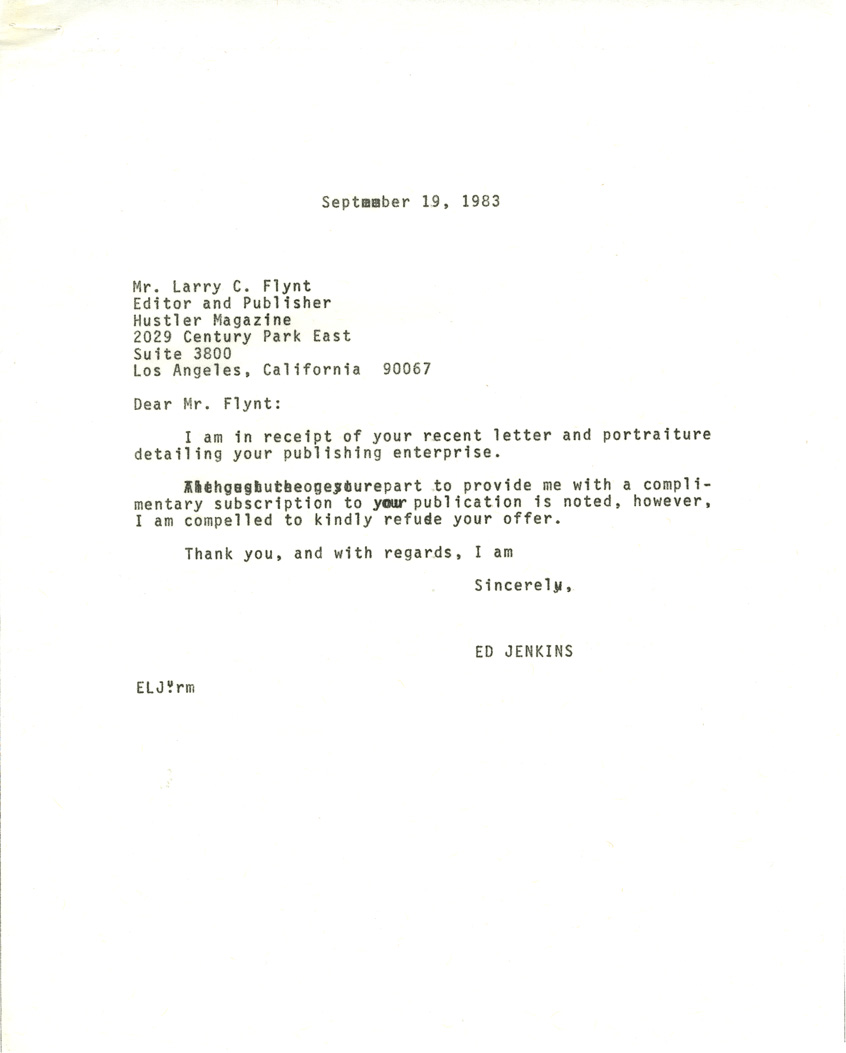
Among the legislation on agriculture, water resources, and immigration laws is a folder entitled “Larry Flynt/Hustler Letters”. The contents of the folder are not as lurid as the popular adult magazine and its notorious creator.  In 1983, the editor and publisher of Hustler wrote to members of Congress offering them complimentary subscriptions to his publication (a practice which he continues today). The folder includes Jenkins’ letter politely declining the offer as well as an article written by Flynt about Larry McDonald, the Georgian Congressman who was aboard the Korean Airlines Flight 007 when the plane was shot down by Soviet interceptors.

What I find most interesting about the letters in this folder is Flynt’s tenacity for exercising free speech.

The Richard B. Russell Library for Political Research and Studies is open for research Monday through Friday from 8:30am to 4:30pm, with the exception of University holidays. For more information, please visit http://www.libs.uga.edu/russell/ or call (706) 542-5788.

Post by Tammi Kim, Processing Assistant for Arrangement & Description Unit, Russell Library

Monday, December 03, 2012

All in the Family

Sometimes collections end up being related to each other in more ways than one! We are fortunate at the Russell Library to receive collections from different families with roots in Georgia politics. Of these “related” collections, we are proud to announce the opening of:

Walter Stovall Papers
Stovall and McKay Family Papers

E. Roy Lambert Papers
Christine D. Lambert Papers

W. Fred Orr and Fred Orr II Papers

George D. Bennett Papers

Margaret V. Clute Collection of Carl Vinson Papers

The Richard B. Russell Library for Political Research and Studies is open for research Monday through Friday from 8:30am to 4:30pm, with the exception of University holidays. For more information, please visit http://www.libs.uga.edu/russell/ or call (706) 542-5788.

Post by Tammi Kim, Processing Assistant for Arrangement & Description Unit, Russell Library

Friday, November 30, 2012

Small and Mighty (2.0)

The Russell Library is proud to announce that several small collections are now open for research. The newly-opened collections include:

Jane Webb Smith Collection of "Baldy" Caricature
Paul Broun, Sr. Collection of Jimmy Carter Presidential Campaign Memorabilia
Wood and Associates Political Advertising Material
W. Frank Barron Papers
Cedar Creek Civic Association Records
Georgia Public Policy Foundation Records
Charles L. Bowden Papers

The Richard B. Russell Library for Political Research and Studies is open for research Monday through Friday from 8:30am to 4:30pm, with the exception of University holidays. For more information, please visit http://www.libs.uga.edu/russell/ or call (706) 542-5788.

Post by Tammi Kim, Processing Assistant for Arrangement & Description Unit, Russell Library

Monday, November 26, 2012

Bittersweet Goodbye

Note: In the post below Russell Library student worker/blogger Beatrice Pollard recounts the time she spent interning for the Obama presidential campaign in 2012, as well as how she spent election night 2012. The opinions expressed here do not in any way represent the views of the Russell Library, which is non-partisan in its mission and activities. This post is simply meant to reflect on the experiences of a college student on the campaign trail.

Like many great goodbyes, the end of a campaign is never quite as predictable as you think. When I reached  the end of the 2012 Presidential campaign trail I was left mostly in a state of uncertainty. On election night as the results flashed across the big screen, I think I felt a little bit of everything -- both happy for the experience and sad it was over, anxious for the outcome and relieved to be finished with the phone calls and canvasing.  And, along with that anticipation came the fear of losing. I realized that I had just become a node in one of the largest, most effective grassroots networks that had reelected the President of the United States – that was a big feeling. For most of us on the ground, this is when it all came full circle, when we as a whole realized that this was bigger than us. Flashbacks to classes in U.S History, America’s revolutionary leaders came to mind as I recognized the cost for this hard fought civil right. In this election year  I mobilized my fellow citizens to participate in their right to vote.

While we all had our separate roles, in the final moments of the campaign we were working under a single heartbeat. After a while, “Fired up and ready to go” became more than a call to action used to motivate supporters, it was embedded in our hearts. The experiences I had working for a campaign this election season were the most valuable part of the process. Listening to stories from Georgians across the state, Atlanta to Augusta to more rural areas, showed me the true diversity that exists in the state population. And our group grew because of what we saw. The melting pot of people on the campaign all found a way to look past individual differences and connect through personal stories about what brought them out to support the President. We were real people working together. It was enough to believe that we as ordinary citizens making phone calls and knocking on doors were making a difference in determining the direction our country might take next. By the end of the summer our team had hosted numerous Get out the vote events and organized dozens of neighborhood teams around the state; that excitement spread and the people we met became dedicated to hosting their own events and getting the word out. We were able to rally Women for Obama, Hispanics for Obama and other diverse segments of the population into coming together as one big support group. Headquarters became busier and I watched as our enthusiasm spilled over into downtown Atlanta and the greater Athens area.

The final days of the campaign became increasingly busy as the race heated up, and I think for most of us the results of the debates and the increasingly close polling numbers were unexpected. But our team continued to work, canvassing neighborhoods, making more phone calls and taking road trips to the battleground states of North Carolina and Florida;  we were determined to make a difference.
I joined with my fellow Obama for America workers and Young Democrats of Athens to watch the election coverage at the Georgia Theater. To have contributed my blood, sweat, and tears for months, it was humbling to sit and watch the early returns, afraid my contribution wasn’t enough. We all sat watching, fixated on the screen as each state was called for Romney or Obama. The race appeared so close and we didn’t know what to expect. Nevertheless, decked out in our Obama pins and unyielding faith, our hopes rose as the numbers began to turn in our favor. In the end, our team helped to win those battle ground states. The biggest feat of all was Florida. Members of our Georgia team had spent dozens of weekends in the undecided state, forming neighborhood teams to talk to undecided voters. . I can’t forget the hours spent forgoing the Georgia-Florida football game festivities to canvass the Florida suburbs. And the phone calls – I’ll never forget the thousands of phone calls. But this was grassroots, and this was real. WE had a lot of reasons to be proud for the big win, but most of them were because we knew first-hand the hard work that goes into a campaign.

In any campaign, beyond all the glitz and the glamour there are real people making calls and logging in the data so we can make the calls again. Never once could I imagine how empowering it would be to have the opportunity to actively participate in election process. When I first signed up I was attracted to the glamour, but I left the experience humbled that someone from Augusta, Georgia could become a mechanism for change. I’ll carry the intimate conversations, the skills, and the optimism to any field I go into in the future. If you have the opportunity to give back to the community whether it is public service or campaigning – go do it. It won’t be the most financially rewarding, but it will definitely change your life.

Post by Beatrice Pollard, Student Worker/Blogger, Russell Library

Thursday, November 15, 2012

Election Day on the Ground in Athens, GA

Note: In the post below Russell Library student worker/blogger Lori Keong recounts how she and many of her fellow UGA students spent Election Day 2012. The opinions expressed by the variety of people Lori interviewed and gathered feedback from do not in any way represent the views of the Russell Library, which is non-partisan in its mission and activities. This post is simply meant to reflect on the way some students on our campus experienced the 2012 Election.   

On Election Day, after sending several texts to friends about their cable services, I lamented the fact that my roommates and I had chosen to skimp on cable TV. Instead, as my roommate and I cozied up around the space heater with a laptop and a bowl of popcorn and as the US map was slowly dyed red and blue with votes rolling in, it was apparent that the race would be as close as recent polls had suggested.

Election Day was the summit of so many months of campaigning from both candidates and personal campaigning from the citizens who supported them. It finally drew a popular victor in candidate debates waged on issues like foreign policy, job creation and unemployment, taxes, healthcare and gay marriage.  Without quite the same oomph as the monumental 2008 election—it was more of a celebration of continuity than of new beginnings—but was still a great day to appreciate the rights that we have as American citizens, most importantly our right to vote.

On Election Day 2012, people rushed to the polls to cast their votes, if they had not already voted early or were voting absentee. Recently, my Facebook newsfeed has been littered with Instagram shots of people boasting peach stickers on their breast emblazoned with “I’m a Georgia voter!” 

After surveying my friends on Facebook before Tuesday, many said they would be spending their day at the polls and then going to class. Others said that they skipped class to vote, while even more dedicated citizens skipped class and traveled home to vote there. One friend joked that he was going to watch Facebook implode since he had already voted early, while another made this tongue-in-cheek comment: “I'm gonna spend the whole day figuring out which of my favorite candidates to vote for! I wish there was a way to elect ALL the candidates!” 

For many friends, it was their first time voting in the general election.  Most of us turned 18 after Obama’s first landslide sweep into office. The older I get since I turned 18, though, the more it becomes apparent to me how socially unacceptable it is to choose not to vote. In the college environment, people who don’t vote, for whatever reason, are openly shamed. “I don’t care which candidate you vote for,” said one of my roommates.  “Everyone should be voting. It’s your civic duty. That’s what I believe.”  Especially with the candidates being so close—even in Georgia, where Romney was expected to win by a large margin, numbers were tight between the two candidates—it seemed even more imperative to cast a vote.

Despite the ever more important role of voting in this close election, there were still many Americans who didn’t vote.  Of friends polled who didn’t register to vote, some said that it was a sign of their discontent with both candidates, others expressed ambivalence about the election, while one or two said that they would have voted Republican in a state that was going to swing that way anyways. 
 A report from the Center for the Study of the American Electorate put 2012 voter turnout at 57.5% of all eligible voters, compared to 62.3% who voted in 2008 and 60.4% who cast ballots in 2004. This year’s voter turnout, however, was still higher than in 2000, when the turnout rate was as low as 54.2%.

This year, the group estimated 126 million people voted in the election, meaning that as many as 93 million eligible citizens did not cast ballots. (Read more about it HERE).

For Election Day coverage, many friends went to the Georgia Theatre and Little Kings Shuffle Club downtown, or to the Tate Center on campus, to watch the results with the UGA Democrats and other organizations. “The girls in my apartment are hosting an election party Tuesday... the day after we host a Guy Fawkes party,” said one friend. Others had the same idea as me: settling in with a bowl of popcorn to watch the election results at home.

When it became apparent that Obama would win the election, my friends rushed back from a viewing party, with some celebrating and others merely accepting the news. Facebook did not implode, but filled with exclamations of relief, “told-you-so’s,” and some disappointment.

Just a few responses from my newsfeed, posted here:

“so the lesser of the two evils won. oh well. our loss that we don't have the good luck of living under ron paul's presidency.”

“Clear eyes. Full hearts. Four more years.”

“Very upset about who will be leading our country for the next four years.”

“Tonight we celebrate. Tomorrow we get back to work. Here's to all you world changers out there.”

“How "For the People" is our government anyway?”

What do the results of the election tell us, though?

A recent article, “The New America,” from CNN paints a good picture of the national atmosphere that rendered the results of this election.  The article noted how progressive the nation has become, as shown by the legalization of marijuana by two states, a record 20 women serving in the US Senate, and the record number of minorities being elected to Congress. According to CNN, the election shows that country is far less conservative than popular belief suggests. However, election results also show a continually fragmented electorate who are still divided on race despite a larger and more diverse population in the United States. (Read more HERE).  

For a larger map of how Election Day played out and people’s favorite moments, check out this Storify of Election Night: 2012 #ElectionDay Highlights http://sfy.co/eAvk  #storify #voting #polling

* In the post above Russell Library student worker/blogger Lori Keong recounts how she and many of her fellow UGA students spent Election Day 2012. The opinions expressed by the variety of people Lori interviewed and gathered feedback from do not in any way represent the views of the Russell Library, which is non-partisan in its mission and activities. This post is simply meant to reflect on the way some students on our campus experienced the 2012 Election.   

Post by Lori Keong, student worker/blogger, Russell Library