Wednesday, September 10, 2014

Homer Wilson on Changes/Constants on Hot Corner


This post was written by Russell Library summer intern Alexander Stephens, an M.A. student in UGA's Department of History. Alex spent time indexing oral histories using software developed by the University of Kentucky's Louie B. Nunn Center for Oral History. With the help of their Oral History Metadata Synchronizer (OHMS)audiovisual content can be indexed with headings and tags. By labeling content with related tags and breaking full interviews into smaller sections, OHMS allows researchers to discover specific stories within larger themes.

In addition to his other work for the Library's Oral History and Media Unit, Alex served as an interviewer for the Athens Oral History Project. Here, he reflects on his conversation with Homer Wilson for AOHP. To hear the full interview, use the links below to visit the OHMS site or Russell Library SoundCloud page

Athenians like to talk about our town being “different” from the rest of the state. A lot of us speak reverently about the unique character of this place. It’s not just different from the rest of Georgia--“it’s just different.”

But when I moved home to Athens after seven years away, I saw what looked to be a familiar pattern. For over half a century, the intersection of Hull Street and Washington Street was a thriving business, arts, and entertainment district owned, operated, and populated by black entrepreneurs and patrons. The area became known as Hot Corner. The Corner still attracts a bustling crowd on weekend nights, but now the scene is dominated by a mostly young and predominantly white crowd. I am generalizing, of course, about a pocket of downtown frequented by people representing a range of identities and communities. My description is probably consistent, however, with what passersby often see. After several years working with a North Carolina community facing rapid gentrification, I assumed I was witnessing the symptoms of a similar trend. I wanted to talk with someone who had seen Hot Corner change over time, and when I had the opportunity to conduct oral history interviews with the Richard B. Russell Library, I knew exactly where I wanted to start.

Walking into Wilson’s Styling Shop feels like walking into a family living room. Whether in for a haircut or not, people come together here to share information and renew friendships. According to Homer Wilson, who succeeded his father as the shop’s owner, it’s always been this way. There are decades-old relationships rooted here. This extraordinary continuity was my first clue to check the assumptions I made about what is happening on Hot Corner. It is true that the area has changed. Brown’s Barber Shop, two doors over from Wilson’s, is the only other business still operated by the same family who ran it when Wilson’s father began running his shop over fifty years ago. Surrounding these historic businesses are bars and restaurants that cater to people representative of the vanguard of gentrification in many urban settings around the country: a relatively young, relatively white crowd of artists, students, and service industry folks. While I fall firmly within no fewer than four of these categories, I saw these changes as net losses. I saw them as indications of displacement, evidence of the erasure of a history. In his gentle and good-natured way, Homer Wilson let me know that I was wrong.

Hear for yourself, by listening to the interview from Clip from 49:30-52:15 on our SoundCloud page (below) or by clicking HERE to visit OHMS


While the makeup of today’s Hot Corner strays from tradition, the spirit here--and the history undergirding it--is far from gone. It was easy for me to look at Hot Corner from the outside and lament a perceived loss. When I talked with Wilson, however, the picture became vastly more complex. To suggest that the significance of Hot Corner could simply be erased is to underestimate the power imbued in its people and its businesses and its barstools. It probably doesn't hurt that the Wilsons maintain ownership of the space they lease to The World Famous or that the Wade family still owns the Manhattan Cafe building. Across the street, the Morton Theater testifies to the vision, business acumen, and artistic clout of black Athenians from the early 20th century to the present. But equally important, as Wilson puts it, there is an enduring “vibe” on Hot Corner. The buzz of clippers from the Corner barber shops has left permanent aural imprints on the brick walls. The footsteps of the teenagers who led the local civil rights movement in the 1960s have etched courage into the pavement. Now, as Wilson sees it, “the spirit” has found its way into neighbors such as Joey Tatum, who has run the Manhattan Cafe for twenty years and Little Kings Shuffle Club for ten. Newcomers have made their own contributions. DJ Mahogany, for example, has spent the past decade at Little Kings supplementing the bass line beneath Hot Corner’s history.

None of this is to suggest that all change is welcome. There are people in Athens, and undoubtedly on Hot Corner, who would be justified in feeling that new trends and new arrivals are encroaching on the communities they have created in the face of discrimination and hardship. It’s important to be aware of the backstory beneath our feet in order to honor the aspirations of the people who laid the foundations on which we stand. It is for this reason that the Wilsons, the Browns, and others with historical ties to the business district founded the Hot Corner Association in 2000. Their aim is to ensure that people learn the history of this place. The Association also works to encourage minority entrepreneurship in downtown Athens, because the descendents of the people who turned Hot Corner into a regional center for black culture and commerce know the value of working for themselves and serving their community.

As painful as it can be, change is in the nature of cities. Wilson understands this fickleness. He watched as other shops moved to bigger spaces on major thoroughfares, creeping outward to malls and planned shopping centers. Heeding his father’s advice to stay downtown, he is now watching business owners eagerly seek out more central locations. Wilson seems unphased by these shifts. Perhaps this is because he knows that on Hot Corner, the spirit is strong enough to shape whatever form change takes.


Monday, September 08, 2014

The Power of Voice: Dean Rusk on the Atomic Bomb

In the spring of 2014, Russell Library student assistant Chelsea Harvey began indexing oral histories using software developed by the University of Kentucky's Louie B. Nunn Center for Oral History. With the help of their Oral History Metadata Synchronizer (OHMS), Chelsea began listening to the personal tapes of former U.S. Secretary of State Dean Rusk and organizing audiovisual content by indexing headings and tags. By labeling content with related tags and breaking full interviews into smaller sections, OHMS allows researchers to discover specific stories within larger themes.

In the fall of 1984, former U.S. Secretary of State Dean Rusk sat down with his son Richard and began recording the stories that had shaped his life and his political career. For the next five years, both father and son would together record over 170 tapes of interviews.

In these tapes, Rusk recalls growing up on a farm in Cherokee County, serving as part of the India Burma China Theater in World War I, and making some of the decisions as Secretary of State that would ultimately guide America into the era of the Vietnam War.

In an interview recorded some time in 1985, Rusk discusses the history of the Rockefeller Foundation, an organization for which he served as president from 1952 to 1960. Rusk explains that during the 1930s, the Foundation funded a number of private research projects concerning nuclear physics and other sciences, including a "cyclotron" at the University of Berkeley that would later be used to create the world's first atomic bomb.


DEAN RUSK: "… among other things we had put some money into the cyclotron at Berkeley. Then along about 1941, the Foundation was called by the director of the laboratory at Berkeley and told that they needed something like a quarter of a million dollars urgently and that they could not tell us why. And the then-trustees of the Foundation decided to go ahead and give them that money. They were somewhat abashed a little bit later, after the war, to discover that what they had done had been an integral part of launching the Manhattan Project."

Rusk goes on to say that many of the projects funded by the Rockefeller Foundation during that time concerned research the American government did not have the budget to fund, creating a tension between the needs of government and those of bureaucracies like the Foundation.

Listening to the tape, it becomes difficult to focus on this clip; Rusk slows his speech, often taking pause before stringing together sentences. While the content is both interesting and relevant, its potency is lost in its clumsy delivery.

Compare this with a story told earlier on a tape in January of 1984, remembering the "flash" of news that the atomic bomb deploying in Hiroshima:


DEAN RUSK:  "I was at my desk in the Operations Division of the General Staff and the flash from Hiroshima was the first I heard about it. I remember, when that flash came in an Air Force Colonel sitting at the next desk exclaimed, 'This means that war has turned upon itself and is devouring its own tail. From this time forward it will make no sense for governments to try to settle their disputes by war.' Well, we haven't fully brought that instinctive insight of his into reality but I have always remembered his remark."

The content itself is nothing new: a powerful, white American male reflects on the emotional impact of the first atomic bomb's physical destruction. But something in Rusk's voice, in his reflection, captivates. There is a quality to the audio content that extends beyond that of the transcript; his stoicism is haunting.

In the case of oral history, audio-visual content captures something missing from the same words transcribed on a page.

Friday, September 05, 2014

The Story of School Lunch: Congressional Food Fight

Over the past two summers Russell Library interns Ashton Ellett and Kaylynn Washnock assisted in curating the new exhibit, “Food, Power, and Politics: The Story of School Lunch” opening September 26th in the Russell Library’s Harrison Feature Gallery. The exhibit examines the complicated past of the National School Lunch Program, from feeding malnourished children and putting excess commodities to good use, to the more recent debates over childhood obesity and nutrition in America. This post is one in a series where Ashton and Kaylynn provide a preview of key documents featured in the exhibition.  
At the end of World War II, proponents of ongoing school lunch programs worried that the federal government’s ad hoc, hand-to-mouth funding scheme discouraged local school districts from participating. Many districts were reluctant to invest scarce funds into capital intensive projects like cafeteria construction and kitchen equipment purchases without guaranteed federal funding.

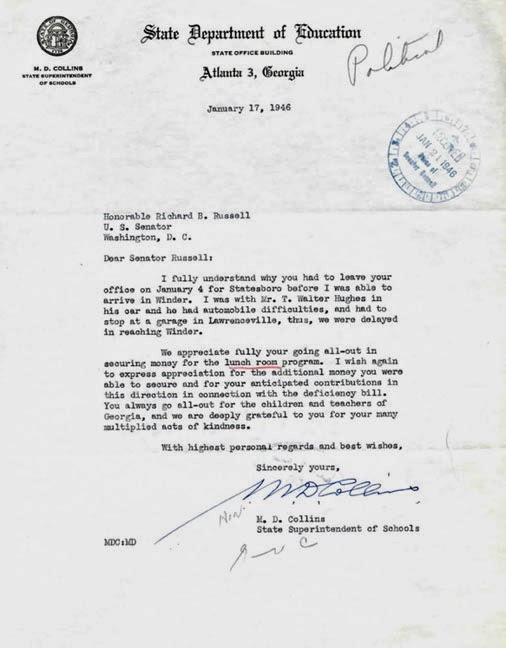
Letter from M.D. Collins to Richard B. Russell
January 17, 1946.
Richard B. Russell, Jr. Collection,
Russell Library. 
Despite a fierce legislative battle over the responsibilities of parents and the role of schools, President Truman signed the National School Lunch Act on June 4, 1946. The passage of the bill was due in large part to the lobbying of a select group of politicians—including Georgia Senator Richard B. Russell. A letter from Dr. Mauney Douglas Collins, State Superintendent of Schools, dated January 17, 1946, to Senator Russell demonstrates the widespread appreciation among education officials in Georgia for his support of the legislation.

A letter from Bob Shields (pages 1-3 below), administrator of the USDA’s Production and Marketing Administration, to Russell in June 1946 stresses the historical importance of the newly passed national school lunch program, which he saw as both a challenge and an opportunity. In his speech before Product and Marketing Administrators, Shields indicated the legislation marked “a new era in farmer-consumer relationship” and reaffirmed the program as “a measure of national security.” During World War II, Major General Lewis B. Hershey, director of the Selective Service System, testified before the House Committee on Agriculture that many young men were rejected for military service because of nutritional deficiencies. With the nation at war and the memory of farmers suffering during the Great Depression at the forefront of many minds, how could the nation’s nutrition and farm problems be solved? The original legislation intended to serve as both a childhood nutrition and surplus commodity program. Since 1946, the U.S. government has been involved in both the “production and marketing” of food because of, according to Shields, the “humanitarian vision and constructive statesmanship.”


In spite of lofty goals, the original National School Lunch Act lacked the legislative provisions and enforcement abilities to serve America’s neediest children. Reform and expansion of the program would come later from another war – one inspired by grassroots activism and social movements of the 1960s.  

Want to find out more about School Lunch? Visit Food, Power, and Politics: The Story of School Lunch on display in the Harrison Feature Gallery of the Special Collections Building from September 26, 2014 through May 15, 2015. The Russell Library gallery is free and open to the public weekdays from 8 a.m.-5 p.m. and on Saturdays from 1-5 p.m. For more information, email russlib@uga.edu or call 706-542-5788.

Thursday, September 04, 2014

40th Anniversary Symposium Scheduled Oct. 27-28


What: Russell Library 40th Anniversary Symposium
When: Oct. 27 (evening); Oct. 28 (8:30 a.m.-5:00 p.m.) Follow us on Twitter (@RussellLibrary) #Russell40
The Richard B. Russell Library for Political Research and Studies will host a scholars and policymakers symposium to celebrate the Library’s 40th anniversary year on Oct. 27-28, 2014 in the Richard B. Russell Building Special Collections Libraries.
Richard Baker, US Senate Historian Emeritus, will kick off the symposium with a keynote address at 6 p.m. on Monday, Oct. 27. On Tuesday, Oct. 28 scholars from across the country will participate in panel discussions, highlighting their use of Russell Library collections in recent publications. Policymakers will join these discussions, building on the historical context of the themes presented and adding commentary on the creation of related public policy and its oversight. Panels will be organized around the Russell Library’s six key collecting areas: Politics, Social Relations, Public Good, Environment, Economy, Peace and War. 
The keynote address and symposium sessions are free and open to the public and will be held in the auditorium on the second floor of the Richard B. Russell Building Special Collections Libraries. For more information contact Jan Levinson at (706) 542-5788 or jlevinso@uga.edu.
And, stay tuned to the blog in the coming weeks as we post updates about our featured speakers! Look for us on Twitter (@RussellLibrary) #RBRL40

Friday, August 29, 2014

The Story of School Lunch: FDR and Surplus Commodities

Over the past two summers Russell Library interns Ashton Ellett and Kaylynn Washnock assisted in curating the new exhibit, “Food, Power, and Politics: The Story of School Lunch” opening September 26th in the Russell Library’s Harrison Feature Gallery. The exhibit examines the complicated past of the National School Lunch Program, from feeding malnourished children and putting excess commodities to good use, to the more recent debates over childhood obesity and nutrition in America. This post is one in a series where Ashton and Kaylynn provide a preview of key documents featured in the exhibition.   

Amidst the Great Depression, the Roosevelt administration began disbursing donations of surplus commodities through several New Deal agencies, including the Federal Emergency Relief Administration (FERA), the Federal Surplus Commodity Corporation (FSCC), and the Surplus Marketing Administration (SMA). But the onset of World War II in 1941 reshaped federal support for lunch programs. Although Congress began rationing supplies and diverting labor to support the war effort, federal grants offered subsidies to school lunch programs for the purchase of food and milk.

Miscellaneous Publication 467,
produced by the USDA, October 1941.


The USDA Miscellaneous Publication No. 467 demonstrates the effect of war on the program. The lunch program peaked during the 1941-1942 school year with nearly 6 million children served annually.

By March of 1941, most states in the economically depressed South and West had enrolled and worked with the Surplus Marketing Administration to receive foodstuffs. Georgia had the highest average for school enrollment in the nation at 61.7 percent. Ultimately, rising food and labor costs forced cuts in lunch service during the war years, which saw numbers dwindle.

At the close of World War II, school lunch proponents found a new advocate in Georgia Senator Richard B. Russell, Jr. With his leadership, the still piece-meal initiative would navigate both houses of Congress and become a mandate of federal law. In 1946, Congress passed the National School Lunch Act establishing a nationwide program.

Want to find out more about School Lunch? Visit Food, Power, and Politics: The Story of School Lunch on display in the Harrison Feature Gallery inside the Richard B. Russell Building Special Collections Libraries from September 26, 2014 through May 15, 2015. The Russell Library gallery is free and open to the public weekdays from 8 a.m.-5 p.m. and on Saturdays from 1-5 p.m. For more information, email russlib@uga.edu or call 706-542-5788.


Friday, August 22, 2014

The Story of School Lunch: Experimentation in the Progressive Era

Over the past two summers Russell Library interns Ashton Ellett and Kaylynn Washnock assisted in curating the new exhibit, “Food, Power, and Politics: The Story of School Lunch” opening September 26th in the Russell Library’s Harrison Feature Gallery. The exhibit examines the complicated past of the National School Lunch Program, from feeding malnourished children and putting excess commodities to good use, to the more recent debates over childhood obesity and nutrition in America. This post is one in a series where Ashton and Kaylynn provide a preview of key documents featured in the exhibition.   

Front cover, USDA Farmer's Bulletin
No. 712 published in March 1916.
Experimentation with school lunch in the United States began during the Progressive Era (1890-1920). In growing urban centers like New York, Philadelphia, and Boston religious institutions, professional women’s groups, and charities launched the first free milk and lunch programs to combat pervasive childhood malnutrition.

As the USDA Farm Bulletin No. 712 noted, “Growing children have special needs in the way of food.” As the future generation of America, the growth of healthy children was of the utmost importance. The USDA’s sample menu relied on available foods according to season. While the winter menu baked apples, the summer diet offered students a variety of fruits.

Without state or federal aid, the majority of American school children continued without a school-provided lunch. But shortly, a period of financial depression and war would reshape thoughts on the issue.


Want to find out more about School Lunch? Visit Food, Power, and Politics: The Story of School Lunch on display in the Harrison Feature Gallery inside the Richard B. Russell Building Special Collections Libraries from September 26, 2014 through May 15, 2015. The Russell Library gallery is free and open to the public weekdays from 8 a.m.-5 p.m. and on Saturdays from 1-5 p.m. For more information, email russlib@uga.edu or call 706-542-5788.

Thursday, August 07, 2014

New Installation in Russell Gallery Connects Visitors to Cartoons, Oral Histories


The History Lives Showcase Gallery occupies the central portion of the Russell Library’s exhibit space inside the Richard B. Russell Building Special Collections Libraries. The gallery features materials drawn from the Russell Library’s collections and highlights six key collecting areas: Politics, Social Relations, Public Good, Environment, Economy, Peace and War. The contents of these cases rotate every six to twelve months and offer visitors a sample of the kind of documents and objects found in the archival collections.

A look at the last installation of the Politics of Peace
and War case in the History Lives Showcase Gallery.
Beginning in August 2014 the cases will showcase a selection of political cartoons drawn from the Clifford H. (Baldy) Baldowski Editorial Cartoon Collection. The cartoons have been matched with the library’s six collecting areas to spotlight stories connected to each of the "politics" areas.

In addition to selecting which cartoons to display, student curator Kaylynn Washnock also sorted through hours of the Russell Library's oral history recordings to find six audio clips that connect with the cartoons on display. The clips were selected from a variety of collections including the Reflections on Georgia Politics Series, The First Person Project, and The Georgia Environmental Oral History Project – all ongoing initiatives of the Russell Library’s Oral History and Media Unit. The clips have been compiled into a playlist on the Russell Library's SoundCloud page.

Signage in the gallery space provides a QR code which, when scanned, will connect a visitor directly to the SoundCloud playlist of audio clips. You blog readers can play these clips directly from the embedded link below! We hope visitors will enjoy this playlist either while they tour the gallery space or from the comfort of their personal computer. Our staff hopes this experiment in the gallery gives visitors a greater sense of the breadth of oral history collections at the library and a quick look into some of the most recent interviews conducted by the Oral History and Media Unit team, Callie Holmes and Christian Lopez.

The Russell Library Gallery is free and open to the public weekday from 8 a.m.-5 p.m. and on Saturdays from 1-5 p.m. For more information on the exhibit, email russlib@uga.edu or call (706) 542-5788.

Friday, August 01, 2014

Powell A. Moore Papers Now Open for Research

Powell Moore in his office during the
Nixon administration, ca. 1974.
The Richard B. Russell Library is pleased to announce that the Powell A. Moore Papers are now open for research. The papers capture Moore's nearly five-decade career involved in legislative affairs, public policy and international relations within the federal government and the private sector   By virtue of his various positions, Moore corresponded and interacted with a wide range of individuals at different levels of the government, including prominent U.S. Senators, and clients in the private sector, from international corporations to foreign governments. His correspondence also documents the myriad of professional and personal inquiries and requests he received. Moore retained a wealth of documentation related to the man who gave him his start in Washington, Senator Richard B. Russell. Moore’s papers also feature information related to the many congressional delegations he accompanied abroad during his tenure. The papers include reports, news clippings, invitations, program materials, artifacts and audiovisual materials related to his work and to numerous presidential campaigns, conventions and inaugurations from 1972 to 2009. Photographs feature portraits of well-known Georgia and national political figures and other images, including six United States Presidents.

Moore’s earliest government service was in the U.S. Army. Part of that time he was stationed in Germany, during the construction of the Berlin Wall, which he credits for his developing an affinity with the Republican Party. The opportunity that brought him to Washington, D.C., in 1966 was his work as press secretary for Senator Richard B. Russell. Moore’s papers go beyond documenting his working relationship with the Senator and also chronicle the period surrounding Senator Russell’s passing. Moore’s life-long interest in Senator Russell’s life and accomplishments is evidenced in the material from dedications and events that have helped keep Senator Russell’s legacy alive.

Moore went on to be part of four presidential administrations. During the Nixon administration he was Public Information Officer in the Office of Attorney General within the Department of Justice. Moore was part of the Committee to Reelect the President during the 1972 campaign and was later the Director of Press Relations for the Inaugural Committee.

Moore with President Gerald Ford, August 1974.
During Nixon’s second term and into the early part of Ford’s term, Moore was Deputy Special Assistant to the President in the Congressional Relations Office. Moore did not remain a “Nixon leftover” for long as he left the federal government to start his own consulting firm, Powell Moore & Company, to advise and represent a variety of clients. After six years, he re-entered government service under the Reagan administration. First he was appointed Deputy Assistant to the President for Legislative Affairs in 1981. Moore oversaw the Senate confirmation of Supreme Court Justice Sandra Day O’Connor while holding this position. He later was appointed Assistant Secretary of State for Intergovernmental and Legislative Affairs.

Powell Moore serving as Assistant
Secretary of Defense for Legislative Affairs
in the George W. Bush administration, May 2001.
Towards the end of 1983, Moore left the Reagan administration to become Vice President for Legislative Affairs for the Lockheed Corporation. He went back to consulting from 1985 to 1998, working for Ginn, Edington, Moore, and Wade; Capitoline International Group; and Global USA. In 1998 he returned to federal government service once again to become Chief of Staff for Senator Fred Thompson.
Moore became part of a fourth presidential administration when he was appointed Assistant Secretary of Defense for Legislative Affairs during George W. Bush’s first term. During this period, he received the Defense Department’s Medal for Distinguished Public Service. He went on to become the Managing Director for Federal Government Relations for McKenna, Long & Aldridge. In 2006, Moore became the Representative of the U.S. Secretary of Defense to the Organization for Security and Cooperation in Europe in Vienna, Austria. In 2010, he joined Venable LLP.

Moore was born on January 5, 1938, in Milledgeville, Georgia. He is a graduate of Georgia Military College and was awarded a Bachelor’s Degree in Journalism from the University of Georgia. Moore remained an active alumnus of both institutions and received a number of honors from them throughout his career. He was editor of the Milledgeville newspaper,  The Union-Recorder, and worked for Southern Natural Gas before working for Senator Russell. Throughout his life he has been involved in a number of civic activities. He currently works as a consultant and lives with his wife, Pamla, in Washington, D.C. Together they have two sons and two daughters.

Moore was interviewed for the Reflections on Georgia Politics oral history series in December 2009. You can view the ROGP interview below through the Russell Library's YouTube channel. To read the interview transcript, visit: http://podcaster.gcsu.edu/podcastdata/UGA/Channel_14896/podcast_2433199/2433199.pdf


The Richard B. Russell Library is open for research from 8:30am-4:30pm, Monday through Friday (with the exception of University of Georgia holidays). For more information on this and other collections call (706) 542-5788, email russlib@uga.edu, or visit www.libs.uga.edu/russell.

Post by Mark Walters, Political Papers Processing Intern, Russell Library 

Monday, July 14, 2014

Memorex: Adventures in Unusual Formats

As 1974 was drawing to a close, Powell A. Moore wrote a letter to President Gerald Ford resigning from his post as Deputy Special Assistant to the President in the White House Office of Legislative Affairs. Moore had been a so-called “Nixon leftover,” having stayed on after Ford entered office. Perhaps he was following standard protocol or perhaps he wanted to use the latest technology, but Moore’s decision to use a Memorex magnetic card as the media to preserve the letter he had written to the President presented me with my first encounter with this piece of 1970s technology while processing the Powell A. Moore Papers during my internship this summer.

A Memorex memory card containing Powell Moore's letter resigning from the
Ford administration.

So what exactly is a magnetic card? To me it looks like a piece of undeveloped film or microfilm without any images, except in the shape and size of a punch card minus the punches. (Without “Powell’s Resignation letter to the President” written on the self-proclaimed “Flexible Folder” in which the magnetic card was enclosed, I would have had no idea what content it contained.) According to the promotional material I discovered online, Memorex released a new “writable surface” magnetic card for use with IBM’s second generation Mag Card II, Mag Card Selectric, and Mag Card Executive typewriters in early 1974. So in order to understand what properties this card has, I needed to look at how the equipment transferred information to and retrieved information from this magnetic card.

All of IBM’s Mag Card typewriters stored information on magnetic cards and had the ability to erase errors by backspacing and typing over the error, automatically saving the new data to the card. New content could be inserted into the text by only typing the changes; what is already stored will appear without the need to retype it. Editing and revising the document happens on the card, not on the sheet of paper. But unlike later word processing typewriters, there was no screen; your only frame of reference was your paper. You had buttons to help you navigate by paragraph, line, and word to get to the location where the correction was to be made. Once errors were corrected and your draft finalized, the typewriter typed your document automatically from the information stored on the card at a rate much faster than even the most skilled typist could type.

It is not possible to tell which type of IBM typewriter Moore used to prepare his letter by examining the magnetic card alone. And the Russell Library does not have the typewriter that could tell us if the card is still viable. In large part because of the cost – the Mag Card II Typewriter was priced at $11,000 in 1973 -- the typewriters and card reader systems would have been restricted to use in an office environment. And the typewriters were never produced on the scale that personal computers came to be, making the format even more obsolete than the floppy disk.

Moore’s position with the federal government led to the creation of a record on this technological format. Had he not used a Memorex magnetic card to preserve his resignation letter, I would not have learned about this small technological current that rose and crested in the 1970s.

Post by Mark Walters, Political Papers Processing Intern
Mark Walters, Russell Library summer intern.


Friday, May 30, 2014

"The Right Leadership at the Top:” The Records of the Georgia Republican Party Chairman

Note: In February of this year, the Russell Library embarked on a one-year project to process the records of the Democratic Party of Georgia (Georgia Democrats) and the Georgia Republican Party (GAGOP), funded by a generous grant of up to $58,777 from the National Historical Publications and Records Commission (NHPRC). In her second blog post for the project, archivist Angelica Marini highlights the role of Chairman of the Georgia Republican Party and the records that illustrate the Chairman’s influence.

In 1995, Rusty Paul, fresh off stints in the federal government, took part in a competitive race for Chairman of the Georgia Republican Party. His campaign literature promoted grassroots activism, political training, and how, as Chairman, he would lead the party to “the next plateau” as “the right leadership at the top.” This statement speaks volumes about how the party viewed itself as an organization at the time. And the records of the Georgia Republican Party show a political organization dedicated to grassroots political action and local politics in the 1990s, but also one that favored top-down, business-style leadership. In particular, the Administrative and Political series in the GAGOP Records provide a unique view of how the party transformed with the election of new executive officers and their appointed administrative staffs and reflect important changes in grassroots leadership, management styles, and fundraising and finance.

The Administrative series contains files of the men who served as Chairman from 1980 to 1998: Bob Bell (1983-1985), Paul Coverdell (1985-1987), John Stuckey (1987-1989), Alec Poitevint (1989-1993), Billy Lovett (1993-1995), and Rusty Paul (1995-1999). (Sue Everhart, the first woman to be elected to this important leadership role, served two terms from 2009 to 2013.) These files contain correspondence, memos, publicity releases, meeting minutes, and major reports and political plans. Additional materials in the Political series consist of candidate and issue research files, convention materials, and district and county files. Taken together, these records offer researchers countless insights into the political leadership, organization, and focus of individual Chairmen and their staffs.

The records of Alec Poitevint, for example, reflect a Chairman who was involved in nearly every aspect of party management. Records from Billy Lovett’s administration are interspersed with the records of the political director, implying a leader who was directly involved with and focused on campaigns. In contrast, the records of Rusty Paul’s chairmanship show a significant redevelopment of planning and political direction for the party as a whole.


Delegate tallies hurriedly scrawled on an Alec
Poitevint bio sheet reflect the quickly changing
fortunes in a chairman's campaign.
The 2013 Rules of the Georgia Republican Party outline the duties of the State Party Chairman and stress the importance of this position. He is the “Chief Executive Officer, chairman of the State Committee, chairman of the State Executive Committee and spokesman of the GRP.” (Rules of the Georgia Republican Party, 2013) He convenes and presides at the State Committee meetings and conventions, and he appoints committees and the positions of General Counsel, Finance Chairman, and other members of the state party staff. While the State Chairman is obligated to appoint individuals to committees and carry out the administrative business of the party, he is also asked to be a “spokesman of the GRP.” Being a spokesman for the Georgia Republican Party includes leading the party in a general direction and providing a solid political plan.

The Georgia Republican Party elects its Chairman at state party conventions held every two years in odd number years. Some of the election cycles for the Chairman position could be quite competitive. Rusty Paul was first elected at the 1995 convention dynamic and remembered it as raucous and fun. He recalled a dynamic convention atmosphere and an election that required a lot of movement; Paul said that “the whole process of watching a convention and how it functioned; it’s not like an election. I mean there’s the ebb and flow of support back and forth. And, you know, you’re on your walkie-talkie listening and you say, well, the delegation in this area has got some questions and you hustle over there to answer questions.”  (Reflections on Georgia Politics Oral History Collection, ROGP 121 Rusty Paul) The elections were often highly competitive as the party grew in size and political strength.

Some conventions could be raucous and fun, but Georgia Republicans at the 1989 state convention were still dealing with political divisions caused by the Republican presidential nominating conventions. In 1988, supporters of religious conservative candidate Pat Robertson threatened to derail the Georgia convention over the presidential nomination. In 1989 delegates at the state party convention were still factionalized and it took four ballots to elect Chairman Alec Poitevint. Files from the convention in Poitevint’s records illustrate how close the election for Chairman was that year; numerous typed and handwritten vote counts taken throughout the convention recorded various election possibilities. A number of convention materials, like the biographical information about Poitevint, have delegate tallies scrawled on them. These recorded vote counts reflect the immediate political campaigning that Rusty Paul described in his interview. As candidates dropped out of the race Poitevint and his team were able to tally up more supporters as delegate votes swung to those still in the race.

In the 1990s Republicans in Georgia experienced very real change in their political landscape. Redistricting based on the 1990 census reflected an explosion in suburban growth in Georgia, a population that largely voted Republican. In 1992 and 1994 Republicans had enormous electoral successes.  As the Georgia Republican Party grew, the state conventions also grew in size and scope. At the 1995 state convention in Savannah -- the first Georgia GOP convention to attract lobbyists -- the growing pains of the party were apparent and the competition for the chairmanship was keen. Candidates that year represented old and new Georgia Republicans -- Christian conservatives, the state party establishment, an expanded base of suburban voters, and newly Republican rural voters.

In that hotly contested 1995 election for Chairman, top candidates had garnered statewide media attention by accusing each other of dirty tricks. Of the four candidates running for the position, Rusty Paul was the perceived outsider and underdog. Paul had plenty of political experience, though. He managed Jack Kemp’s campaign for the Republican presidential nomination in 1988 and served as a Bush appointee in the Department of Housing and Urban Development, in the early 1990s. He didn’t think he would win but thought running would be a good way to get back into state politics.

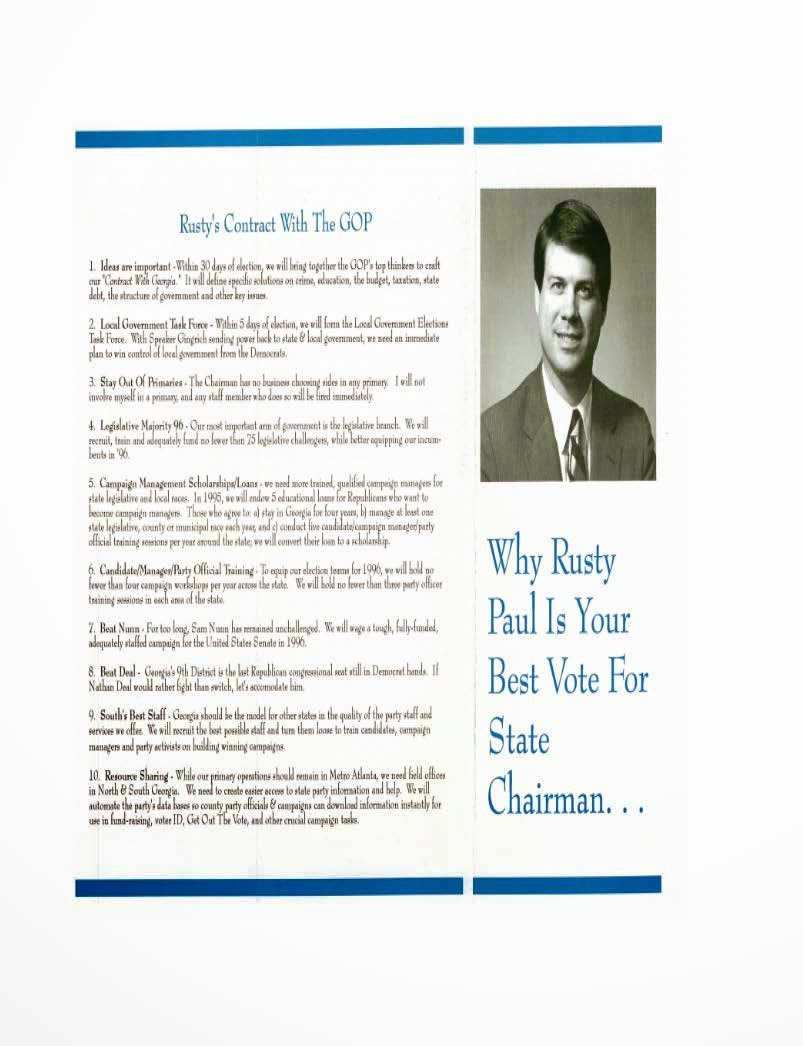
"Rusty's Contract With The GOP" makes the
case for Paul as the party's next Chairman.
“The way we would select a chairman of the Republican Party,” Paul explains, “is different than any other office. I mean, you run around the state like you’re a statewide candidate but instead of talking to voters you’re talking to people who are likely to be the delegates to their local conventions. Whether it’s their precinct caucus, or their county convention, their congressional district convention, and then the state convention.”  (Reflections on Georgia Politics Oral History Collection, ROGP 121 Rusty Paul) Paul’s commitment to running for the office of Chairman was in part what got him elected. His distance from perceived problems in the state party, his experience managing political campaigns, and his political plan for the party made him an appealing choice. His campaign literature focused on making a positive impact on Georgia politics. Paul capitalized on recent Republican successes and pitched “Rusty’s Contract With the GOP,” a la Newt Gingrich’s 1994 Contract With America, in his campaign literature.
 

The Administrative and Political Series together shed light on the personal leadership styles of the individuals at the top of the party. As a result, these records provide researchers a fuller, more complex picture of the GAGOP as an organization.

Next up:  The role of the GAGOP’s Executive Director and the development of political plans…