Showing posts with label Political Slang. Show all posts

Monday, November 26, 2012

Bittersweet Goodbye

Note: In the post below Russell Library student worker/blogger Beatrice Pollard recounts the time she spent interning for the Obama presidential campaign in 2012, as well as how she spent election night 2012. The opinions expressed here do not in any way represent the views of the Russell Library, which is non-partisan in its mission and activities. This post is simply meant to reflect on the experiences of a college student on the campaign trail.

Like many great goodbyes, the end of a campaign is never quite as predictable as you think. When I reached  the end of the 2012 Presidential campaign trail I was left mostly in a state of uncertainty. On election night as the results flashed across the big screen, I think I felt a little bit of everything -- both happy for the experience and sad it was over, anxious for the outcome and relieved to be finished with the phone calls and canvasing.  And, along with that anticipation came the fear of losing. I realized that I had just become a node in one of the largest, most effective grassroots networks that had reelected the President of the United States – that was a big feeling. For most of us on the ground, this is when it all came full circle, when we as a whole realized that this was bigger than us. Flashbacks to classes in U.S History, America’s revolutionary leaders came to mind as I recognized the cost for this hard fought civil right. In this election year  I mobilized my fellow citizens to participate in their right to vote.

While we all had our separate roles, in the final moments of the campaign we were working under a single heartbeat. After a while, “Fired up and ready to go” became more than a call to action used to motivate supporters, it was embedded in our hearts. The experiences I had working for a campaign this election season were the most valuable part of the process. Listening to stories from Georgians across the state, Atlanta to Augusta to more rural areas, showed me the true diversity that exists in the state population. And our group grew because of what we saw. The melting pot of people on the campaign all found a way to look past individual differences and connect through personal stories about what brought them out to support the President. We were real people working together. It was enough to believe that we as ordinary citizens making phone calls and knocking on doors were making a difference in determining the direction our country might take next. By the end of the summer our team had hosted numerous Get out the vote events and organized dozens of neighborhood teams around the state; that excitement spread and the people we met became dedicated to hosting their own events and getting the word out. We were able to rally Women for Obama, Hispanics for Obama and other diverse segments of the population into coming together as one big support group. Headquarters became busier and I watched as our enthusiasm spilled over into downtown Atlanta and the greater Athens area.

The final days of the campaign became increasingly busy as the race heated up, and I think for most of us the results of the debates and the increasingly close polling numbers were unexpected. But our team continued to work, canvassing neighborhoods, making more phone calls and taking road trips to the battleground states of North Carolina and Florida;  we were determined to make a difference.
I joined with my fellow Obama for America workers and Young Democrats of Athens to watch the election coverage at the Georgia Theater. To have contributed my blood, sweat, and tears for months, it was humbling to sit and watch the early returns, afraid my contribution wasn’t enough. We all sat watching, fixated on the screen as each state was called for Romney or Obama. The race appeared so close and we didn’t know what to expect. Nevertheless, decked out in our Obama pins and unyielding faith, our hopes rose as the numbers began to turn in our favor. In the end, our team helped to win those battle ground states. The biggest feat of all was Florida. Members of our Georgia team had spent dozens of weekends in the undecided state, forming neighborhood teams to talk to undecided voters. . I can’t forget the hours spent forgoing the Georgia-Florida football game festivities to canvass the Florida suburbs. And the phone calls – I’ll never forget the thousands of phone calls. But this was grassroots, and this was real. WE had a lot of reasons to be proud for the big win, but most of them were because we knew first-hand the hard work that goes into a campaign.

In any campaign, beyond all the glitz and the glamour there are real people making calls and logging in the data so we can make the calls again. Never once could I imagine how empowering it would be to have the opportunity to actively participate in election process. When I first signed up I was attracted to the glamour, but I left the experience humbled that someone from Augusta, Georgia could become a mechanism for change. I’ll carry the intimate conversations, the skills, and the optimism to any field I go into in the future. If you have the opportunity to give back to the community whether it is public service or campaigning – go do it. It won’t be the most financially rewarding, but it will definitely change your life.

Post by Beatrice Pollard, Student Worker/Blogger, Russell Library

Thursday, November 15, 2012

Election Day on the Ground in Athens, GA

Note: In the post below Russell Library student worker/blogger Lori Keong recounts how she and many of her fellow UGA students spent Election Day 2012. The opinions expressed by the variety of people Lori interviewed and gathered feedback from do not in any way represent the views of the Russell Library, which is non-partisan in its mission and activities. This post is simply meant to reflect on the way some students on our campus experienced the 2012 Election.   

On Election Day, after sending several texts to friends about their cable services, I lamented the fact that my roommates and I had chosen to skimp on cable TV. Instead, as my roommate and I cozied up around the space heater with a laptop and a bowl of popcorn and as the US map was slowly dyed red and blue with votes rolling in, it was apparent that the race would be as close as recent polls had suggested.

Election Day was the summit of so many months of campaigning from both candidates and personal campaigning from the citizens who supported them. It finally drew a popular victor in candidate debates waged on issues like foreign policy, job creation and unemployment, taxes, healthcare and gay marriage.  Without quite the same oomph as the monumental 2008 election—it was more of a celebration of continuity than of new beginnings—but was still a great day to appreciate the rights that we have as American citizens, most importantly our right to vote.

On Election Day 2012, people rushed to the polls to cast their votes, if they had not already voted early or were voting absentee. Recently, my Facebook newsfeed has been littered with Instagram shots of people boasting peach stickers on their breast emblazoned with “I’m a Georgia voter!” 

After surveying my friends on Facebook before Tuesday, many said they would be spending their day at the polls and then going to class. Others said that they skipped class to vote, while even more dedicated citizens skipped class and traveled home to vote there. One friend joked that he was going to watch Facebook implode since he had already voted early, while another made this tongue-in-cheek comment: “I'm gonna spend the whole day figuring out which of my favorite candidates to vote for! I wish there was a way to elect ALL the candidates!” 

For many friends, it was their first time voting in the general election.  Most of us turned 18 after Obama’s first landslide sweep into office. The older I get since I turned 18, though, the more it becomes apparent to me how socially unacceptable it is to choose not to vote. In the college environment, people who don’t vote, for whatever reason, are openly shamed. “I don’t care which candidate you vote for,” said one of my roommates.  “Everyone should be voting. It’s your civic duty. That’s what I believe.”  Especially with the candidates being so close—even in Georgia, where Romney was expected to win by a large margin, numbers were tight between the two candidates—it seemed even more imperative to cast a vote.

Despite the ever more important role of voting in this close election, there were still many Americans who didn’t vote.  Of friends polled who didn’t register to vote, some said that it was a sign of their discontent with both candidates, others expressed ambivalence about the election, while one or two said that they would have voted Republican in a state that was going to swing that way anyways. 
 A report from the Center for the Study of the American Electorate put 2012 voter turnout at 57.5% of all eligible voters, compared to 62.3% who voted in 2008 and 60.4% who cast ballots in 2004. This year’s voter turnout, however, was still higher than in 2000, when the turnout rate was as low as 54.2%.

This year, the group estimated 126 million people voted in the election, meaning that as many as 93 million eligible citizens did not cast ballots. (Read more about it HERE).

For Election Day coverage, many friends went to the Georgia Theatre and Little Kings Shuffle Club downtown, or to the Tate Center on campus, to watch the results with the UGA Democrats and other organizations. “The girls in my apartment are hosting an election party Tuesday... the day after we host a Guy Fawkes party,” said one friend. Others had the same idea as me: settling in with a bowl of popcorn to watch the election results at home.

When it became apparent that Obama would win the election, my friends rushed back from a viewing party, with some celebrating and others merely accepting the news. Facebook did not implode, but filled with exclamations of relief, “told-you-so’s,” and some disappointment.

Just a few responses from my newsfeed, posted here:

“so the lesser of the two evils won. oh well. our loss that we don't have the good luck of living under ron paul's presidency.”

“Clear eyes. Full hearts. Four more years.”

“Very upset about who will be leading our country for the next four years.”

“Tonight we celebrate. Tomorrow we get back to work. Here's to all you world changers out there.”

“How "For the People" is our government anyway?”

What do the results of the election tell us, though?

A recent article, “The New America,” from CNN paints a good picture of the national atmosphere that rendered the results of this election.  The article noted how progressive the nation has become, as shown by the legalization of marijuana by two states, a record 20 women serving in the US Senate, and the record number of minorities being elected to Congress. According to CNN, the election shows that country is far less conservative than popular belief suggests. However, election results also show a continually fragmented electorate who are still divided on race despite a larger and more diverse population in the United States. (Read more HERE).  

For a larger map of how Election Day played out and people’s favorite moments, check out this Storify of Election Night: 2012 #ElectionDay Highlights http://sfy.co/eAvk  #storify #voting #polling

* In the post above Russell Library student worker/blogger Lori Keong recounts how she and many of her fellow UGA students spent Election Day 2012. The opinions expressed by the variety of people Lori interviewed and gathered feedback from do not in any way represent the views of the Russell Library, which is non-partisan in its mission and activities. This post is simply meant to reflect on the way some students on our campus experienced the 2012 Election.   

Post by Lori Keong, student worker/blogger, Russell Library

Tuesday, October 16, 2012

Presidential Debates: Strategy & Importance

Historically, the presidential debates have been the end of the road vehicle by which candidates nail down their positions on issues before voting begins—especially for independent voters—and attempt to solidify their claims of being the most reliable candidate to steer the nation. 

How effective are the debates though?  According to Chris Cillizza from the Washington Post, unless a definitive, overwhelming victory is secured by either candidate, the debates won’t mean much. Cillizza continued, saying, “Most people who tune in will have made their minds up about who won (and who they are going to vote for) before a word is uttered by either candidate — and, in the post-debate analysis, they’ll tune in to whatever commentary best fits that view. For the tiny sliver of undecided voters, it’s hard to imagine they will find a reason to choose either candidate.”

However, today’s town hall style presidential debate at Hofstra University, catered to the American people, will perhaps have more sway on the undecided.  A group of undecided voters selected by the Gallup Organization will have their chance to clarify pre-election qualms by asking candidates questions on foreign and domestic issues. The two candidates will then each have two minutes to respond.

This debate, commented a recent Politico article, will take place in an environment “more suitable for share-your-pain moments than aggressive attacks” where candidates will need to come off more personably, connecting with the audience and answering questions more directly. Additionally, “because candidates are free to walk about, town halls are body-language danger zones.”

Al Gore in a past debate, for example, was criticized for rolling his eyes while Bush was speaking, which translated poorly with voters.  As it is critical to convey a respectable impression, antics like Biden’s jovial laughter and frequent interruptions during last Thursday’s VP debate—behavior that was criticized as condescending and disrespectful—would not be well-received.

Obama, feeling the pressure to perform after reviews of the first presidential debate painted him as ‘lackluster’ and  ‘uninspired,’ headed for debate training camp this weekend in Williamsburg, VA. He promised his supporters a more aggressive performance in Tuesday's rematch with Romney, and will have to compensate for his slipping lead in the polls. 

Poll results by Gallup following the first debate show Romney catching up to Obama by a few points, suggesting that Romney has improved his public image, something he has struggled to polish throughout the campaign.  According to a Politico/George Washington University Battleground poll, 51% of likely voters now view Romney favorably, compared with 44% who view him unfavorably. Before the debate, the poll results showed 47% having a favorable view and 49% unfavorable.

Comparing presidential debates through history, an article by the San Francisco Chronicle says that Romney’s win in the first debate falls in line with history. “It’s much, much easier to be the challenger. In all the debate cycles since 1960 — 10 of them — the candidate of the party NOT in power came out of the debates having scored points eight times: Kennedy over Nixon, Carter over Ford, Reagan over Carter…”

Even so, this debate will be an opportunity and a risk for Romney to convince voters that he is in-step with the middle-class and the poor. While the economy and unemployment will likely continue to be a central issue in Tuesday’s debate, others have suggested that last week’s vice-presidential showdown will likely inspire a rehashing of issues such as Libya, abortion rights, and Romney’s now-infamous “47 percent” quote.

For Athenians interested in local debate action, consider joining the Russell Library for a debate watch event tonight, October 16th, starting at 8PM. Free coffee and snacks, and commentary from Professor Jamie Carson of UGA's Political Science Department. Plus, live tweeting! #RBRLelection

The Full Debate Schedule: http://blogs.sacbee.com/capitolalertlatest/2012/10/am-alert-with-california-bill-deadline-come-and-gone-its-on-to-election.html

Post by Lori Keong, student worker/blogger, Russell Library

Thursday, October 11, 2012

Voting! (Some Reminders)

Your vote is your voice in the governance of your city, county, state and country and the 2012 Election Day is just around the corner (Tuesday, November 6, 2012). As a citizen, you declare your rights and privileges with your vote and that single vote can make a difference! The following are a few reminders/tips to help you navigate procedures at the polls...

When do I vote?
Polls are open from 7:00 a.m. until 7:00 p.m. on each election day. However, any voter who is waiting in line to vote at 7:00 p.m. will be allowed to vote. Peak voting hours are historically from 7:00 a.m. until 9:30 a.m., 4:30 p.m. until 7:00 pm, and during the mid-day lunch hour.

Thinking of ways to beat election day traffic at the polls? Learn more about early voting HERE.
 
Where do I vote?

Each voter must vote at the polling place designated for the precinct in which the voter lives - the location of your polling place is located on your precinct card. If you have misplaced your card or do not know where your precinct is located, please use this poll locator

Voting on Election Day
When you arrive at your polling place, you will complete a voter's certificate which asks for your name and residence address. You will then present the certificate and proper identification to the poll officials who will verify that you are a registered voter in that precinct by checking the voters list for that precinct. Voters are required to present identification at their polling place prior to casting their ballot. Proper identification shall consist of any one of the following:

(1) A Georgia driver's license which was properly issued by the appropriate state agency;

(2) A valid voter identification card or other valid identification card issued by a branch, department, agency, or entity of the State of Georgia, any other state, or the United States authorized by law to issue personal identification containing a photograph;

(3) A valid United States passport;

(4) A valid employee identification card containing a photograph of the elector and issued by any branch, department, agency, or entity of the United States government, this state, or any county, municipality, board, authority, or other entity of this state;

(5) A valid United States military identification card containing a photograph of the elector;

(6) a valid tribal identification card containing a photograph of the elector

A first time registrant by mail may also provide one of the following additional forms of identification: a copy of a current utility bill, bank statement, government check, paycheck or other government document that shows the name and address of the elector.

If the elector is a first time registrant by mail who did not provide one of the acceptable forms of ID at the time of registration this voter must show proper identification. If the elector is unable to show identification at the time of voting they may vote a provisional ballot which will be counted only if the voter presents identification within the 2 day period following the election.

If your name is found on the voter list, you will be issued a voter access card and admitted into a voting booth to cast your vote using an electronic touch screen voting unit After you cast your ballot the machine will automatically eject the voter access card and you will return the card to a poll official. Instructions on how to operate the electronic touch screen voting unit are posted at each polling place and you may ask a poll official for assistance.

All this information and more is available at the Georgia Voting Information Website. For national voting registration information OR for more information about military/overseas voting, voting as a student, or voting as a felon, visit rockthevote.org. We hope to see you all at the polls on November 6!

Post by Lori Keong, student worker/blogger, Russell Library

Thursday, August 30, 2012

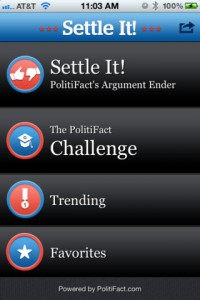
PolitiFact’s “Settle It!”: An App Review

Since websites like Snopes.com were created to assess the truthfulness of urban legends, chain e-mails, rumors, and other misinformation spread online, people have been looking for a quick and easy way to settle the truth once-and-for-all.

A new app from Pulitzer Prize-winning website PolitiFact could do just that, settling debates and silencing know-it-alls. Called “Settle It!,” the free app, available for iPhone and Android devices,  is based on the PolitiFact website—founded and run by the Tampa Bay Times since August 2007—which has become the largest political fact-checking website on the web.

The app draws largely from PolitiFact’s constantly updated content and borrows its main functions, like PolitiFact’s signature Truth-O-Meter system. The Truth-O-Meter relies on a few ratings for checking facts: True, False, Mostly True, Mostly False, Half True, and Pants on Fire (reserved for only the most ridiculous falsehoods). 

However, to improve on its new app, PolitiFact got together with a handful of “journalists, technologists, and idealists” for an idea session—hosted by NPR—to figure out what concepts and features they wanted to have.

Here are the fruits of their labor:

Design
The app has a simplistic Twitter-like interface and search feed that focuses on being user-friendly.  Searches using key words bring up a scrollable list of relevant quotes next to images of the people who said them. A search with the key words “same sex marriage,” for example, presented statements from well-known politicians/pundits to the not-so-well-known—among them were quotes from Barack Obama, Mitt Romney, senate delegate Bob Marshall, and popular Facebook posts.

Features
Think you know your stuff? Other features of the app include the PolitiFact Challenge, a fun game which allows players to test whether they can recognize the factuality of statements. The game, which has users pick between “True,” “False,” and “Pants on Fire” ratings, also works on a point system. Earning points for each correct answer, players can move up through five player levels, from “Intern” to “Aide,” then from “Lobbyist” to “Pundit,” and finally to the highest level, “Wonk.”

Another, the “trending” feature shows the most buzzworthy current statements. The most popular statement at the moment is from Romney—“I didn’t inherit money from my parents”—which received a rating of “Half True.”

The app also allows you to share information with friends or opponents via Facebook, Twitter, and e-mail.

Even if you can’t find what you’re looking for, the app allows you to submit your own requests for specific statements.

What’s the Verdict?
PolitiFact’s “Settle It!” does what it’s intended to do—and does it very well. Easy to use and easy to navigate, the app effectively draws lines of truth and fiction in tough debates where you need to be up on your facts and figures.

With PolitiFact Challenge and its interactive functions, the app also fulfills its goal of encouraging “engagement in democracy.”

What’s great about “Settle It!” is that the app not only gives you a verdict for individual statements, but breaks down its reasoning in layman’s terms. For those who are looking for a quick answer for a given topic, beneath the Truth-O-Meter, the site gives you a succinct explanation of why the statement was so right or so wrong.  However, the site will also give you a full rundown of the quote’s origin and the facts or misinformation behind it. It even samples excerpts from key documents (like the Constitution and the healthcare mandate) to point out exactly where people have misinterpreted text.

A large effect of the app is the comfort of having an on-demand service of fact checking. The posts are updated very frequently. Perhaps if you had the more convincing argument in a dinner table debate with Settle It!’s help you would even feel a lingering sense of satisfaction.

But the most lasting impression that the app and PolitiFact can give is a sense of accountability for speech and the written word—not only from the policy makers and elected officials that we anticipate will know their facts, but from the average person as well, to think and review their facts before they disseminate “Half Truths” and even “Pants on Fire” rumors to the larger digital world.  

Links to download the app are available at http://www.politifact.com/settleit/ 

Post by Lori Keong, Student Worker/Blogger, Russell Library


Wednesday, August 29, 2012

Swing States


Over the course of American history, voting in swing states, or battleground states, has been a strong reflection of the national mood and has been essential to shaping presidential election outcomes. For example, the swing states of Ohio, Connecticut, Indiana, New Jersey and New York were crucial to the outcome of the 1888 election. Grover Cleveland narrowly beat Benjamin Harrison with a slim majority in the popular vote after Harrison swept four swing states in the Electoral College. More than 70 years later, in one of the closest elections in American history, Illinois and Texas would boost young, grinning JFK to the presidency.  Florida, after its disastrous voting controversy, was the key to the 2000 election and even more recently, Ohio aided George W. Bush to his reelection in 2004.

The 2012 Presidential election seems sure to be another tight race. Over recent months poll results have begun to even out between Obama and Romney. Both candidates have pumped hundreds of thousands of dollars into advertising in critical swing state cities like Cleveland, Ohio and Tampa, Florida. Politico, a political journalism organization, broke down polling averages in battleground states in a recent chart updated on its website, which shows that Romney, although still tailing Obama in most swing states, is playing catch-up fast – making significant gains across the board.

While Obama’s term has been the most telling display of what he could offer if he were re-elected, all eyes are now on the Romney/ Ryan team and the GOP.  Can Romney pull a fast one in the last bend of the curve? Will he be able to pull off what he has struggled to convey throughout the campaign—a convincing, reliable candidate who America can trust to remain firm and honest in his views?

Recently, conservative Congressman Akin (R-MO) stepped down after his “legitimate rape” comments sparked furor from women’s rights groups and people from across the political spectrum. Though Republicans hastily cut ties with Akin, the comments pushed the abortion debate back into the forefront of the political arena. Ryan has been grilled on his views on abortion, gingerly dancing around the subject, although a spokeswoman for the Romney/Ryan campaign has said the two would not oppose abortion in the case of rape and incest.

Akin’s comments have brought attention to just one of a string of social issues that have divided candidates. Women’s rights have been one of the central issues in this presidential contest, from the contraception clause in the healthcare mandate to abortion, while same-sex marriage remains a topic of contention.

On the other hand, despite his appeals to independent voters that he is the pliable candidate with the will to compromise, Obama’s handling of healthcare, the state of the economy, and the high unemployment rate (still hovering around 8%) could be major roadblocks in his bid to win swing state votes. “The incumbency advantage enjoyed by President Obama,” said Kenneth Bickers, a political science professor at the University of Colorado, said, “though statistically significant, is not great enough to offset high rates of unemployment currently experienced in many of the states." However, of the 12 swing states seen as critical in deciding November's presidential contest, two-thirds have unemployment rates below the national average, and four, including Ohio, have a lower unemployment rate than they did when President Obama took office.

“The fact that the majority of voters in the crucial states that will decide the election believe they are not better off is [also] a challenge for the Obama campaign. That includes 50% of independent voters in the swing states, in addition to 36% of Democrats and 84% of Republicans saying they are not better off [5].” –Gallup.com

Nearly 10 weeks before Election Day, both candidates are still courting battleground states (as the RNC began this week and the DNC begins soon) and touting promises on education and energy, among other topics. Who’s making the biggest gains? You’ll have to keep track of the polls. 

Post by Lori Keong, Student Worker/Blogger, Russell Library

Thursday, January 05, 2012

The Bradley Effect

After correctly projecting winners of gubernatorial, U.S. Senate, and presidential elections in California in 76 out of 80 statewide contests since 1948, the Field Poll is widely considered the state’s most accurate pollster. Indeed, the last Field Poll survey of a general election often tracks the actual election margin within one or two percentage points, and the last survey to predict the wrong winner in a polled contest came in 1982. At the time, Los Angeles mayor Tom Bradley, the Democratic nominee for governor, was shown leading Republican state Attorney General George Deukmejian by a convincing margin of eight points. As potentially the first elected African-American governor in history, Bradley’s candidacy had generated considerable excitement. On Election Night, exit polls indicated a Bradley victory. But once the votes were tallied, Deukmejian won the election by about 100,000 votes and 1.2% of the total 7.5 million votes cast. Ever since his unexpected triumph pollsters have spoken of a supposed Bradley effect that plagues black candidates. This theory suggests that voters often tell pollsters they are either undecided or will support the black candidate in an election, but will actually stay home or vote for a white candidate on Election Day. Whether or not a Bradley effect exists—and a former Deukmejian pollster denies that it did even in that 1982 contest—its causes are hotly disputed.

Deukmejian won popularity during his governorship as a fiscal conservative following President Reagan’s mold of slashing allegedly wasteful domestic programs. He defeated Bradley once more in 1986, this time by a lopsided margin of 61-37. Ultimately, the first elected black governor in American history would arrive in 1989 when Democrat Doug Wilder won the governorship of Virginia. Again, observers noted a “Bradley effect” in that Wilder’s margin was close enough to warrant a statewide recount after polls had shown him leading Coleman by four to 15 points and even the Election Night exit poll had predicted a 10-point Wilder win. The same night, David Dinkins, also a Democrat, became New York City’s first African-American mayor, defeating Republican nominee Rudy Giuliani by some two percentage points after leading him by 18 and 14 points, respectively, in the two final polls of the race. A similar outcome had occurred in the Chicago mayoral election of 1983.

Wilder and Dinkins both left office after elections in 1993—Wilder was limited to one term in office and Dinkins lost another close race to Giuliani. The later 1990s and early 2000s proved a fairly poor era for black candidates, with no African-American governors elected and the only black U.S. Senator (Carol Moseley Braun) defeated for reelection in 1998. After the election of another black governor, Deval Patrick of Massachusetts, in 2006, and Sen. Barack Obama’s 2007 presidential announcement, the Bradley effect received considerable scrutiny regarding its continued applicability in an age of purportedly higher racial tolerance.

Throughout the 2008 primary campaign, pundits speculated whether Obama’s poll numbers would significantly overstate his on-the-ground support. However, with the single exception of a campaign-resuscitating come-from-behind win for Hillary Clinton in New Hampshire, Obama’s numbers largely matched or exceeded the polls when votes were tallied. In Southern states particularly, he was known to surpass his polled support. In South Carolina, the poll aggregator website RealClearPolitics showed an Obama lead of 12 points, but he won by 29. He similarly over-performed in Democratic primaries in Georgia, Virginia, Wisconsin, and North Carolina. During the general election campaign, with “Bradley effect” talk again in full swing as Obama maintained consistent polling leads over Republican Sen. John McCain, popular analyst Nate Silver wrote in Newsweek that “there is no reason to conclude that the polls are systematically overestimating Obama’s support.” Indeed, RealClearPolitics’ final poll average on November 3 showed an Obama popular vote lead of 7.6%, an almost perfect match for the eventual 7.3% outcome. RealClearPolitics also projected that Obama would win 338 electoral votes to McCain’s 200. The final result was 365-173.

Whether or not the Bradley effect existed in the 1980s, most agree that there is little evidence for it in closely watched, competitive elections today.

Tuesday, November 29, 2011

The Fourth Estate

The news media is sometimes referred to as the Fourth Estate of politics. Nineteenth century writers attributed this usage to British parliamentarian Edmund Burke, who used it in a 1787 debate over whether or not to allow press attendance at House of Commons proceedings. In Burke’s reckoning, the other three estates were members of Parliament—Lords Temporal, Lords Spiritual, and Commons—and this framework itself referenced medieval Europe’s “three estates” of clergy, nobles, and commoners. Today, the news media plays a vital role in shaping popular perceptions of events, history, and candidates for public office. Certain politicians have even used their own status as “media darlings” to their advantage when seeking office, while others play off the perceived media antagonism to their campaigns to gain public sympathy.

For an example of the latter, we need look no further than Richard Nixon. His resentful attitude about press coverage of his 1960 presidential race against John F. Kennedy (particularly their televised debates) significantly impacted the rest of his political career. After losing the California gubernatorial race in 1962 to Democratic incumbent Pat Brown he declared, “You won’t have Nixon to kick around anymore because, gentlemen, this is my last press conference.” When seeking the White House again in 1968, Nixon urged the nation’s “Silent Majority” to stand against liberal elites in the press, the Capitol, and on college campuses. The famous “Enemies List” penned in 1971 included dozens of major media figures at nearly every high-circulation newspaper and magazine. Even while under siege during the Watergate investigation in 1973-74, a beleaguered Nixon continued to push back against mounting allegations with dismissive remarks about the popular press’s motivations, and behind the scenes (as revealed by his infamous white house tapes) he made derisive and sometimes obscene remarks about such personalities as Katharine Graham, editor of The Washington Post.

Another Republican presidential hopeful, John McCain, benefited greatly from media coverage in his 2000 primary campaign against George W. Bush. Running on a “maverick” platform that mixed traditional conservative stances on cultural issues and tax policy with reformist proposals on campaign finance reform and management of the federal budget surplus. McCain traveled in a bus dubbed the Straight Talk Express and was said to use every opportunity for positive publicity, including touring the Sunday talk show circuit throughout 1999 discussing the Kosovo conflict and his experience as a prisoner of war in Vietnam. McCain won a 49-to-30 percent victory over national frontrunner Bush in the New Hampshire primary, earning much of his support from moderate Republicans and crossover Independents. A further surge of press coverage ensued for McCain, whose supporters affectionately dubbed themselves “McCainiacs,” heading into the crucial GOP primary in South Carolina.

After a poll showed McCain leading Bush by five points in the conservative state, Bush allied himself on stage with a veteran’s activist, J. Thomas Burch, who accused McCain of “coming home from Vietnam and forgetting us.” The South Carolina campaign would go down in political history as among the most vicious in modern memory, as a still-unidentified party delivered mail and push polls claiming (variably) that McCain had fathered a child out of wedlock, was a “Manchurian candidate” psychologically broken from his days in Vietnam, or that his wife Cindy was a drug addict. Meanwhile, conservative talk show host Rush Limbaugh attacked McCain as a favorite of Democrats and the “liberal media.” Bush defeated McCain in the Palmetto State by 53 percent to 42 percent, and despite victories in Michigan and his home state of Arizona, along with continued sympathy in media circles, McCain’s campaign failed to recover. When he again sought the presidency in 2008, McCain found it difficult to revive his erstwhile press adoration with national newcomer Barack Obama in the race.

Many months (even years) into the campaign season for the 2012 presidential race, its interesting to think about how (of if) the press is shaping the way we see potential candidates. Is there a media darling in the Republican race already?

Monday, November 21, 2011

A is for Aardvarking

Aardvarking is a little-known practice in electoral politics in which, the story goes, campaign consultants recruit candidates whose names start with “A” (or another letter early in the alphabet) to run in low-profile races in which neither candidate is likely to garner media attention or possess high name recognition. Purportedly in elections that voters are paying only minimal attention to, they will tend to support whichever candidate has a name (first or last) that falls noticeably earlier in the alphabet than his or her opponent’s.

Whether aardvarking is an actual phenomenon or a political junkie’s urban legend is very much up for debate, but it is attested to by Republican consultant Roger Stone. He writes that “in the late 1970’s a Republican consultant and I examined a series of races on Long Island when [sic] two candidates who were complete unknowns and who had no campaign resources to raise their profile. In 90% of the races the candidate who's [sic] name began with A won.” Stone offered the “aardvark effect” as an explanation for unemployed private citizen Alvin Greene’s upset victory in South Carolina’s Democratic primary for U.S. Senate last year. Greene’s opponent, the state party’s favored choice and a comparatively seasoned candidate, was named Vic Rawl. If Stone’s eye-popping 90% statistic is true, it could be explained by the alleged phenomenon that voters choose whichever candidate is listed first when they are indifferent as to an election’s outcome.

Some states and localities list candidates in alphabetical order by name and, in those that list candidates’ names randomly, the candidate with the alphabetically earliest name would presumably have even odds with his or her opponents of appearing first. Thus the overall probability, assuming a state had some locales using alphabetical order and some using random order, would favor “Adam Alberts” beating “Ricky Jones.” But all of this might be completely invented. In the case of Alvin Greene, South Carolina State Rep. Bakari Sellers echoed the idea that Greene won due to ballot order. But State Sen. Robert Ford, a fixture in South Carolina politics and the African-American community, controversially speculated that Greene won because black voters recognized his surname as African-American and voted in ethnic solidarity.

Whatever the reason, supposed election flukes do occur, and the lower-profile the election the more likely one will happen. While almost no one would say they vote for President based on the order of candidate names, many people openly admit to voting arbitrarily in local races. Especially when nothing more than a candidate’s name has been widely publicized. In Stone’s words, “Why does Adam Alberts beat Ricky Jones 90% of the time? Who knows?”

Friday, November 11, 2011

What's the Third One?

In light of this election season’s widely covered Republican debates, including one just this week that has already achieved media notoriety, we thought it a good time to delve into a brief history of presidential debates. In recent decades, presidential debates have become an expected part of the electoral process, both during party primaries and the general election.

Though not a single general election presidential debate was held in the nation’s history until 1960, there were several precedents for that landmark cycle. Republican presidential nominee Wendell Willkie challenged President Franklin Roosevelt to a radio debate in 1940, but Roosevelt had refused. Primary debates occurred between Republicans Tom Dewey and Harold Stassen in 1948, and Democrats Adlai Stevenson and Estes Kefauver in 1956. In August of that year, a University of Maryland undergraduate named Fred Kahn contacted the university’s president along with the national chairmen of both political parties, the Governor of Maryland, and Eleanor Roosevelt suggesting that both major party presidential nominees meet in person to answer questions from a panel of college students. Mrs. Roosevelt, a reform-minded activist until her death six years later, endorsed the idea and forwarded Kahn’s letter to Stevenson’s campaign manager. Though nothing came of the proposal in 1956, it would influence the Kennedy and Nixon campaigns to agree to debate four times in 1960, though the first debate would draw by far the largest television viewership -- 66 million viewers (about 37% of the entire American population).

That first debate, held September 26, 1960 at the studios of CBS’ WBBM-TV in Chicago, is famed today for the divergent ways in which its television and radio audiences perceived the outcome. Gallup phone and in-person surveys in the days after showed that the television-viewing audience largely considered Kennedy, who appeared tanned, rested, and alert, the debate victor. Meanwhile radio listeners (a smaller audience by far) thought that Nixon—who had worn a rumpled shirt and refused to wear makeup for the camera—had won. Political pundits by and large felt that Kennedy had triumphed, but that Nixon won the following two debates, while the final debate (a forum on Cuba-U.S. relations held October 21st) was more or less a draw. You can judge for yourself; the first debate has been uploaded to YouTube in portions starting here.

Nixon later ascribed his loss to Kennedy in part to his poor camera presentation in that first debate, and refused to debate opponents Hubert Humphrey in 1968 or George McGovern in 1972. Nor did Lyndon Johnson and Barry Goldwater face off at any point in the 1964 campaign. Thus the next general presidential debate would not occur until 1976, when a strong initial performance for Gerald Ford on domestic policy was offset by a second debate about foreign policy in which the sitting President appeared unaware of Soviet domination in Eastern Europe. Debates were perhaps a more decisive factor four years later, with only one held between President Jimmy Carter and challenger Ronald Reagan. Audiences widely agreed that Reagan had won; the retired actor and ex-governor scored with memorable lines like “there you go again” and “are you better off now than you were four years ago?” After that debate the polls moved from a rough tie between Carter and Reagan to a convincing Reagan lead, and the Republican would best Carter by 9 points come Election Day.

Since the early 1990s, presidential debates have increasingly been governed by memorandum of understanding (MOU) between the two major-party candidates and have gradually become highly formal, carefully crafted affairs. While some amusing visuals emerged in debates during the 1990s and 2000s—George H. W. Bush repeatedly checking his watch during a 1992 debate with Bill Clinton and Ross Perot, Al Gore sighing skeptically during George W. Bush’s rebuttals in 2000, Bush the younger’s “He forgot Poland” remark in 2004—rarely do contemporary general election debates shake up the campaign state of play or provide clear front runners amid an otherwise muddied race anymore. If debates ever did greatly influence presidential election outcomes, it is difficult to imagine that in today’s exceedingly structured format they would still be able to. Then again, instances like this remind us that presidential debates are still capable of creating some unforgettable campaign moments.

Thursday, October 27, 2011

It's All About the Benjamins

In our previous post on soft money, we discussed in brief the modern history of campaign finance law in the United States, with particular focus on legislation that regulates contributions. With the 2012 presidential election season already setting fundraising records, we consider today the recent history of presidential campaign spending.

While it is difficult to find credible statistics on campaign spending prior to the Federal Election Campaign Act’s (FECA) 1974 amendments, it is no secret to most voters that the cost of presidential campaigns has far outpaced inflation in recent years. Candidates are increasingly judged before the earliest primary election contests by their fundraising ability above their debate skills, knowledge of contemporary issues, or dedication to public service. Readers might still be surprised, however, to learn just how dramatic the cost increases have been (especially since 2000).

Below is a table with statistics courtesy of the Center for Responsive Politics. The second column uses dollar figures unadjusted for inflation, while the third converts all sums into 2010 dollars and the third shows percentage increase in presidential campaign spending cycle-to-cycle using those real dollars:

Election Year

Nominal Dollars Spent by Presidential Candidates

Real Dollars Spent by Presidential Candidates

Change from Previous Campaign Cycle

1976

$66.9 million

$253.3 million

1980

$92.3 million

$241 million

-4.87%

1984

$103.6 million

$214.6 million

-10.98%

1988

$210.7 million

$383.3 million

+78.63%

1992

$192.2 million

$294.9 million

-23.06%

1996

$239.9 million

$329.9 million

+11.87%

2000

$343.1 million

$430 million

+30.35%

2004

$717.9 million

$821.6 million

+91.07%

2008

$1,324.7 million

$1,340.5 million

+63.16%


Maybe (in part) as a result of FECA’s newly created public financing and stringent contribution disclosure systems, campaign spending decreased in real terms for Ronald Reagan’s two elections and (perhaps surprisingly) for the three-way 1992 contest between Bill Clinton, George H. W. Bush, and Ross Perot. But the highly negative 1988 campaign between Bush and Michael Dukakis saw a monstrous 79% real-dollar increase in presidential spending above 1984’s level, and a downright eye-popping 91% surge came in 2004 with the rise of advertising by independent “527 groups” free of some of the most burdensome campaign finance regulations imposed on parties and PACs by the Bipartisan Campaign Reform Act of 2002, better known as McCain-Feingold.

By 2008, these outside groups had become a critical part of the electoral process, and pundits largely expect their influence to rise in the 2012 campaign. All told, the 2008 presidential race cost some 429% more in real terms than did that in 1976, even though both featured protracted primary contests for one party and fairly high voter interest. But what about fundraising and spending for next year’s presidential election?

Barack Obama’s campaign reached one million donors on October 17 and reported some $60 million cash on hand as of September 30 of this year, a major psychological milestone for a reelection effort fighting the tide of a sluggish economy and widespread voter discontent. Obama’s major Republican opponents are no fundraising slouches either. Mitt Romney’s campaign collected $14 million in the third quarter of 2011, with some $14.65 million cash on hand and, reportedly, a much smaller donor base than one million. Will the 2012 campaign top 2008’s $1.3 billion total tab? And what effects will the Supreme Court’s much-publicized 2010 decision Citizens United v. FEC have on “independent political expenditures” by corporate and labor groups seeking to elect certain candidates and promote associated causes? Check back with us in November 2012.