Tuesday, September 18, 2012

The State of the Economy

Just as the Arab Spring attuned the collective imagination of the world to the possibilities of revolt and protest, the world slowed its tracks about a year ago to watch its economic institutions beset by masses of Guy Fawkes masks and discontented people bearing signs of the 99% vs. the 1%--the haves and have-nots. Even here in Athens-Clarke county, people in North Campus pitched their tents, rolled out their blankets and prepared to protest local and national economic conditions. But on the first anniversary of the Occupy Movement, the issues that incited the revolution still remain. The recession, though improved since recovery efforts began in 2008, has tightened purse strings and diminished prospects. Gas prices are rising with no sign of coming back down. Many recent graduates find themselves idling without a stable job prospect in sight. In Europe especially—as the fight to save the Euro rages on and the economies of several countries (e.g. Greece, Ireland, Spain) are still on the down and downs—it is apparent that the economic pressure America faces continues to be felt by the rest of the world as well.

The Fed released reports Monday saying that uncertainty over the economic outlook increased the unemployment rate by one or two points to where it is now, around 8 percent. According to an article from the Arizona Times, one of the job market’s main problems is a mismatch in skills and training, with jobs becoming increasingly technical. Others say that outsourcing has killed domestic tech and manufacturing fields. This bears bad news for Obama’s campaign as he struggles to relate his competency concerning the economy over this past term, but doesn’t bode much better for Romney, who, if elected, will inherit the same Sisyphean struggle of stimulating and maintaining economic growth.

Ben Bernanke, chairman of the Federal Reserve, was trending all over the web recently for his statements urging for increased intervention from the Fed to boost the economy. To his credit, by September 14, stock prices were already showing signs of improvement after the Fed stepped in again to aid the ailing economy.  The Fed's action followed a decision by the European Central Bank to support debt-ridden euro zone nations by purchasing their debt.

“Policies from Congress, not more short-term stimulus from the Fed, are the ingredients necessary for restoring growth in the American economy,” statement Senator Bob Corker (R-TN) after Bernanke’s speech.

In response to this statement, though, can we even overcome partisan politics to enact lasting economic change?

An article by the Christian Science Monitor compares ways the two presidential candidates differ on issues like the government’s role in job creation, outsourcing, labor unions, and the minimum wage. Obama proposed last September to set aside about $450 billion to cover funding for teachers and improving rundown schools (citing education as most important for job creation) but the bill was quickly shot down in the Senate, which couldn’t determine how to pay for this plan. Romney has said repeatedly that Washington is an impediment to economic growth, but for different reasons. Saying that government regulation only harms the job market, Romney has said he will instead cut the corporate tax rate by about 10%.

But what do tax cuts and budget cuts mean in the grand scheme of the national economy?

Last week’s Russell forum on national security highlighted just how complex the issue of the national budget can be for the American people. Economic figures are tricky. They are difficult to digest and it’s hard to get numbers in context even when they are understood.  Though forum participants were very certain that the defense budget needed to be cut, no one was sure by how much. The same could be said of other sectors of the budget—including education, labor, and industry. Which sectors would we taper to balance the budget? What are the tradeoffs of these cuts? How should we stimulate the economy while keeping our costs down? Should we change our international trade policies and put more investment into American industry?

There is no easy answer. However, if you think you have some answers to these tough questions and want a chance to weigh in on the discussion, come out to the Russell Library’s economic forum on Tuesday, September 18, to engage in balanced discussion with members of your local community.

Post by Lori Keong, Student Worker/Blogger, Russell Library

Monday, September 17, 2012

So Close Yet So Far (from the DNC)

I spent most of the day on Wednesday September 5, 2012 daydreaming; in less than twenty-four hours I would ride to Charlotte, North Carolina to attend the 2012 Democratic National Convention.

I had found out only the week before, tipped off by a cryptic phone call from campaign staff in Atlanta asking for my mailing address. One of the perks of working for any political campaign is the opportunity to attend catered events and receptions where administration officials speak. But when the ticket arrived, a ticket that would admit me to the Bank of America Stadium to see President Obama accept the nomination of his party -- this particular opportunity was the best yet!

I chose my clothes for the next day carefully, ironing each piece and laying them out for the early morning drive. I packed my bags and charged my camera in preparation for the festivities. It wasn’t until about 9 p.m. Wednesday night that I heard plans might change. Staff from Obama for America called to say that unfortunately, due to severe weather forecasts, the convention would be moved to the indoor Time Warner Center, a venue with more limited seating. He assured me the decision was for the safety of all attendees.

Even with this disappointing news, some fellow summer staff members and I decided to wing it, making the drive to Charlotte to see what else might be in store. When we arrived early Thursday, excited and boisterous fans filled the streets—all ready to celebrate this official moment with the delegates, political leaders and community organizers. 

Once in town, we confirmed with campaign staff that our community credentials would not guarantee us entry into the Time Warner Center. Instead, we were invited to a conference call with the President at 1:20 p.m. and were promised an additional opportunity to attend a more intimate event with the President at a time closer to the November election. Once on the line, the President assured us that while a phone call couldn’t replace seeing his speech in person, this moment was what campaigns were really all about -- community, fellowship, and the undying perseverance that comes from those with a common goal.

While we couldn’t see Barack Obama in person, he reminded us of the work we had left to do in this hard fought political race. And in the end, I think he was right. It is often the little moments that make the campaign trail so special. I spent most of my day in Charlotte talking with other convention hopefuls as well as local citizens. There was the pastry shop owner who had seen her highest sales ever since the convention started. Also, there were crews of volunteers who had flown in from Tennessee, Ohio, New York and more hoping, like me, for a chance to meet the President they campaigned hard for all summer long. That night we all gathered together for a watch party and although we didn’t see the speech live, we were all inspired together and felt connected to a campaign dedicated to change.

Post by Beatrice Pollard, student worker/blogger, Russell Library

Thursday, September 13, 2012

A Day in the Life of a Campaign Staffer

All that jazz - some campaign ephemera from the collections
Richard B. Russell Library for Political Research and Studies.
While a typical day for a campaign staffer isn't quite as glamorous as Jim Messina's job (campaign manager for the Obama for America) it can definitely get exciting. Beyond the glitz and the glam you might see on TV -- campaign jargon, catchy slogans, patriotic t-shirts and banners-- the behind the scenes work of campaigning is very different.

I started volunteering for the Obama campaign in the summer of 2012, glittery eyed and star struck thinking I might even walk hand and hand with the President himself. I had a rude awakening my first day. Not only was I highly unlikely to meet the President, but most of my time would be spent making phone calls – lots of them!

From the outside looking in, the campaign trail can seem like a breeze. You see staff members running around with political leaders and walking through crowds of rallying Americans excited to cheer the candidate (and you) on. In reality, a campaign is a lot of work and it takes a while to get to the rallies and election night. Not only do you have to believe in your cause, but you have to show others that they can believe in it too. That task requires lots of resources, stamina and sleep.

As staffers, our job was to connect with people by telling them about the candidates strengths. Through various one-on-one meetings with people in communities throughout the Southeast region, making phone calls, hosting catered events, and door-to-door canvassing, I was able to connect with people on a more intimate basis. Essentially, just letting them know we were on their side and that the candidate needed their help. The citizens appreciated the time we spent reaching out and as we planned events and talked with voters, campaign staff members, as a group, became more unified in working toward our common goal.

Most of my time on the campaign trail was focused on communication. That meant making phone calls to gauge people’s support or stance on key issues, communicating this collected data to campaign HQ, and sharing the importance of voting using tested Get out the Vote methods like door-to-door canvassing and community outreach initiatives. This was not a journey for the shy or weak hearted! Campaign staff and volunteers must be prepared to talk a lot, share experiences with others and use their hands! So, here's a quick break down of the day-to-day...

Day-to-Day Campaign Staffer Run down (The Less Glamorous Side)
•    Making Phone Calls
•    Performing Data Entry using Vote builder, valuable data software of all registered voters
•    Soliciting Donations in person through catered events
•    Canvassing door-to-door
•    Communicating on Dashboard (a Social Network for supporters and interested volunteers)
•    24/7 hr. work days. Lots and Lots of pizza, chips, cookies and other quick junk food

The Perks:
•    Meeting political leaders in the community
•    Attending fundraising receptions
•    A chance to attend the party convention AND Inauguration
     (should the candidate be elected)
•    Friendships forged with fellow staff members
•    Feeling like I made a difference!

So if you’re interested in volunteering for a political campaign, try to remember while you are out there canvassing and making phone calls that your work is not all in vain. Adopt an alter ego, become a super hero taking on the challenges of a new world, and remember to get some sleep! Wanna get involved in a campaign this season? Check out your local political party headquarters for more information on candidates running for office and how you can volunteer.

Post by Beatrice Pollard, student worker/blogger, Russell Library

Monday, September 10, 2012

Redefining U.S. Foreign Policy

“Sometimes to understand where you are, you need to ransack the past,” says Tom Engelhardt, acclaimed author and Fellow of the Nation Institute, where he runs a news commentary website called Tomdispatch.com.

America’s role in the global community is a double-edged sword. The United States has had a hand in so many different countries, whether with an open palm to provide aid or a clenched fist to proclaim war—or a dangerous combination of both, that it is hard to determine all the costs of our dominance abroad.

What we do know is that with continually shifting international trends comes the need for a redefinition of American foreign policy. Previously, “waves of democratization and sectarian strife across Eastern Europe, Central Asia and Africa” at the end of the Cold War pushed America—as the reigning superpower—to the fore in an “experimental era of international peacekeeping,” said a recent GulfNews article. Later, 9/11 encouraged another shift in diplomatic strategy towards combating international terrorism. The destabilization of some regions of the world with the proliferation of weapons of mass destruction also forced us to become more aware of our international adversaries, strengthening our desire to control and influence exterior forces.

In a thorough article that he wrote for Tomdispatch, Engelhardt explains his personal viewpoint on the troubles America faces with national defense now. Recalling the language of emperors of the Hellenic past, Engelhardt describes the recent international counterinsurgency regimes under Bush/Cheney and Obama as attempts to impose a Pax Americana on the world through dominion overseas, in nations like Pakistan and Afghanistan. 

Engelhardt counts these as the components and effects of the Pax Americana:
•    A commander-in-chief with almost unlimited control over domestic defense policy (even at the expense of the American people and the welfare of foreign civilians)
•    Cooling of international relations in response to America’s global peacekeeping attempts
•    Expansion of covert ops--Special forces can be sent wherever the president wants and whenever the president wants; Expanding use of drone air forces against foreign nations can be lethal, given their destructive effect and the president’s extensive power to launch them
•    Expense of millions of dollars to national defense, while other sectors like education are being cut in the national budget
•    Growing detachment of American people to wars and operations launched on America’s behalf

Today, in response to these controversial defense tactics and criticism over continual global peacekeeping efforts, in what ways could we reform our foreign policy? How do we respond to pertinent international trends like the Arab Spring (particularly the continuing crackdowns in Syria), the collapse of the Euro, and the emergence of Africa as a strong trading partner? Can our new president redefine our international policy to adapt to these changes?

According to political reporter Kurt Shillinger, “an abiding feature of foreign policy is continuity from one president to the next,” so he said that though Romney’s plan of action was uncertain, Obama would likely deliver a fairly straightforward plank building on nuclear containment in Iran and North Korea, encouraging continued reforms in budding democracies like Myanmar, continual combat of Al Qaeda members, and strengthening economic partnerships with  the big players on the Pacific Rim.
    The key to asserting influence abroad, though, he said, would be determined by whether the incoming president could find a healthy balance between the rising U.S. debt and the cost of infrastructure and education, with the presidential debates in October providing “the last big opportunity for candidates to address these issues.”
 
To discuss what global security means in the 21st century and possible solutions to our global relations issues, come out to the Russell Library’s national security forum, “America’s Role in the World,” on Tuesday, September 11. 

Post by Lori Keong, Student Worker/Blogger, Russell Library


Thursday, August 30, 2012

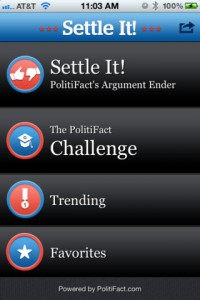
PolitiFact’s “Settle It!”: An App Review

Since websites like Snopes.com were created to assess the truthfulness of urban legends, chain e-mails, rumors, and other misinformation spread online, people have been looking for a quick and easy way to settle the truth once-and-for-all.

A new app from Pulitzer Prize-winning website PolitiFact could do just that, settling debates and silencing know-it-alls. Called “Settle It!,” the free app, available for iPhone and Android devices,  is based on the PolitiFact website—founded and run by the Tampa Bay Times since August 2007—which has become the largest political fact-checking website on the web.

The app draws largely from PolitiFact’s constantly updated content and borrows its main functions, like PolitiFact’s signature Truth-O-Meter system. The Truth-O-Meter relies on a few ratings for checking facts: True, False, Mostly True, Mostly False, Half True, and Pants on Fire (reserved for only the most ridiculous falsehoods). 

However, to improve on its new app, PolitiFact got together with a handful of “journalists, technologists, and idealists” for an idea session—hosted by NPR—to figure out what concepts and features they wanted to have.

Here are the fruits of their labor:

Design
The app has a simplistic Twitter-like interface and search feed that focuses on being user-friendly.  Searches using key words bring up a scrollable list of relevant quotes next to images of the people who said them. A search with the key words “same sex marriage,” for example, presented statements from well-known politicians/pundits to the not-so-well-known—among them were quotes from Barack Obama, Mitt Romney, senate delegate Bob Marshall, and popular Facebook posts.

Features
Think you know your stuff? Other features of the app include the PolitiFact Challenge, a fun game which allows players to test whether they can recognize the factuality of statements. The game, which has users pick between “True,” “False,” and “Pants on Fire” ratings, also works on a point system. Earning points for each correct answer, players can move up through five player levels, from “Intern” to “Aide,” then from “Lobbyist” to “Pundit,” and finally to the highest level, “Wonk.”

Another, the “trending” feature shows the most buzzworthy current statements. The most popular statement at the moment is from Romney—“I didn’t inherit money from my parents”—which received a rating of “Half True.”

The app also allows you to share information with friends or opponents via Facebook, Twitter, and e-mail.

Even if you can’t find what you’re looking for, the app allows you to submit your own requests for specific statements.

What’s the Verdict?
PolitiFact’s “Settle It!” does what it’s intended to do—and does it very well. Easy to use and easy to navigate, the app effectively draws lines of truth and fiction in tough debates where you need to be up on your facts and figures.

With PolitiFact Challenge and its interactive functions, the app also fulfills its goal of encouraging “engagement in democracy.”

What’s great about “Settle It!” is that the app not only gives you a verdict for individual statements, but breaks down its reasoning in layman’s terms. For those who are looking for a quick answer for a given topic, beneath the Truth-O-Meter, the site gives you a succinct explanation of why the statement was so right or so wrong.  However, the site will also give you a full rundown of the quote’s origin and the facts or misinformation behind it. It even samples excerpts from key documents (like the Constitution and the healthcare mandate) to point out exactly where people have misinterpreted text.

A large effect of the app is the comfort of having an on-demand service of fact checking. The posts are updated very frequently. Perhaps if you had the more convincing argument in a dinner table debate with Settle It!’s help you would even feel a lingering sense of satisfaction.

But the most lasting impression that the app and PolitiFact can give is a sense of accountability for speech and the written word—not only from the policy makers and elected officials that we anticipate will know their facts, but from the average person as well, to think and review their facts before they disseminate “Half Truths” and even “Pants on Fire” rumors to the larger digital world.  

Links to download the app are available at http://www.politifact.com/settleit/ 

Post by Lori Keong, Student Worker/Blogger, Russell Library


Wednesday, August 29, 2012

Swing States


Over the course of American history, voting in swing states, or battleground states, has been a strong reflection of the national mood and has been essential to shaping presidential election outcomes. For example, the swing states of Ohio, Connecticut, Indiana, New Jersey and New York were crucial to the outcome of the 1888 election. Grover Cleveland narrowly beat Benjamin Harrison with a slim majority in the popular vote after Harrison swept four swing states in the Electoral College. More than 70 years later, in one of the closest elections in American history, Illinois and Texas would boost young, grinning JFK to the presidency.  Florida, after its disastrous voting controversy, was the key to the 2000 election and even more recently, Ohio aided George W. Bush to his reelection in 2004.

The 2012 Presidential election seems sure to be another tight race. Over recent months poll results have begun to even out between Obama and Romney. Both candidates have pumped hundreds of thousands of dollars into advertising in critical swing state cities like Cleveland, Ohio and Tampa, Florida. Politico, a political journalism organization, broke down polling averages in battleground states in a recent chart updated on its website, which shows that Romney, although still tailing Obama in most swing states, is playing catch-up fast – making significant gains across the board.

While Obama’s term has been the most telling display of what he could offer if he were re-elected, all eyes are now on the Romney/ Ryan team and the GOP.  Can Romney pull a fast one in the last bend of the curve? Will he be able to pull off what he has struggled to convey throughout the campaign—a convincing, reliable candidate who America can trust to remain firm and honest in his views?

Recently, conservative Congressman Akin (R-MO) stepped down after his “legitimate rape” comments sparked furor from women’s rights groups and people from across the political spectrum. Though Republicans hastily cut ties with Akin, the comments pushed the abortion debate back into the forefront of the political arena. Ryan has been grilled on his views on abortion, gingerly dancing around the subject, although a spokeswoman for the Romney/Ryan campaign has said the two would not oppose abortion in the case of rape and incest.

Akin’s comments have brought attention to just one of a string of social issues that have divided candidates. Women’s rights have been one of the central issues in this presidential contest, from the contraception clause in the healthcare mandate to abortion, while same-sex marriage remains a topic of contention.

On the other hand, despite his appeals to independent voters that he is the pliable candidate with the will to compromise, Obama’s handling of healthcare, the state of the economy, and the high unemployment rate (still hovering around 8%) could be major roadblocks in his bid to win swing state votes. “The incumbency advantage enjoyed by President Obama,” said Kenneth Bickers, a political science professor at the University of Colorado, said, “though statistically significant, is not great enough to offset high rates of unemployment currently experienced in many of the states." However, of the 12 swing states seen as critical in deciding November's presidential contest, two-thirds have unemployment rates below the national average, and four, including Ohio, have a lower unemployment rate than they did when President Obama took office.

“The fact that the majority of voters in the crucial states that will decide the election believe they are not better off is [also] a challenge for the Obama campaign. That includes 50% of independent voters in the swing states, in addition to 36% of Democrats and 84% of Republicans saying they are not better off [5].” –Gallup.com

Nearly 10 weeks before Election Day, both candidates are still courting battleground states (as the RNC began this week and the DNC begins soon) and touting promises on education and energy, among other topics. Who’s making the biggest gains? You’ll have to keep track of the polls. 

Post by Lori Keong, Student Worker/Blogger, Russell Library

Tuesday, August 28, 2012

1957 Civil Rights Act

It was 55 years ago today that Senator Strom Thurmond, then a Democrat from South Carolina, launched the longest filibuster in American history in opposition to the Civil Rights Act of 1957. Taking the Senate floor at 8:54 PM on August 28 armed with throat lozenges and malted milk balls, Thurmond would continue speaking, with only brief interruptions for questions from other Senators, until 9:12 PM the next night – a filibuster lasting 24 hours and 18 minutes. This surpassed by almost two hours the previous record set by Oregon Senator Wayne Morse four years prior. During his daylong near-monologue, Thurmond read the election laws of all 48 states, the Declaration of Independence, the Bill of Rights, George Washington’s Farewell Address, and his mother’s biscuit recipe.

The Act Thurmond opposed so vehemently was, in the canon of federal civil rights legislation, a minor entry. Though aimed at ensuring suffrage for African-Americans in the South, it did not seek to ban racially discriminatory practices such as the poll tax and dubious “literacy tests” administered in Southern states. The 1957 Civil Rights Act did, however, establish a Civil Rights Division within the U.S. Department of Justice to protect the rights of would-be black voters. Today that division is still known for enforcing federal voting rights, anti-discrimination, and hate crimes laws in federal court. John Doar, a Civil Rights Division lawyer in the 1960s and Assistant Attorney General for the Civil Rights Division during the Johnson administration, described the division’s early activities and test cases in a 1997 article for the Florida State University Law Review.

The 1957 Civil Rights Act was not nearly the watershed moment for civil rights its 1964 successor – which banned both race and gender discrimination in employment and service – or the 1965 Voting Rights Act would prove to be. Indeed, between 1957 and 1960 black voter registration in the South inched up just three percent, a tiny increase compared to the strides made after 1965. Still, it was the first federal civil rights legislation since Reconstruction, after which racial laws in the South had taken something of a backward lurch for several generations, and as such, Thurmond spoke for a number of Southern Senators in opposing the Act’s passage. Yet many of his fellow Southerners were angered by Thurmond’s filibuster; they had informally agreed not to filibuster the bill but to water it down instead. Time reported on September 9 that Herman Talmadge, the junior Democratic Senator from Georgia and an ardent segregationist himself, had derided Thurmond’s effort as a “grandstand of longwinded speeches” which could “in the long run wreak unspeakable havoc upon my people.” Even Thurmond’s staffers had not been informed of his plan.

The filibuster, though long, failed to derail a deeply compromised Civil Rights Act. The Senate approved the final bill by a 62-15 vote just hours after Thurmond yielded the floor, and it would pass the House by a 270-97 margin before reaching President Eisenhower’s desk for enactment into law. The Act would be strengthened in 1960 and replaced by further-reaching civil rights legislation over the next decade. Thurmond, however, would continue a long and storied career in the Senate. He became a Republican in September 1964, largely in reaction to the beefed-up Civil Rights Act of that year championed by President Johnson, and served in the Senate until January 3, 2003. Thurmond died later that year, aged 100 and after some 48 years in office. His record for Senate service would be surpassed by Democratic Senator Robert Byrd of West Virginia in 2006, but his filibuster record stands unchallenged, now a relic of an era in which such procedures were far more commonplace than they are today.

Monday, August 20, 2012

Ready, Steady, Vote! Fall Program Series

Could your election season use a little non-partisan entertainment? If so, then plan to join the Richard B. Russell Library for Political Research and Studies for Ready, Steady, Vote! a program series focused on getting citizens in the mood for the 2012 election season.

A combination of film screenings, community forums, debate watch events, and stump speeches, Ready, Steady, Vote! is free and open to the public. All events will take place on the 2nd floor exhibit level in the new Richard B. Russell Building for Special Collections Libraries, Georgia’s newest cultural destination. Dates and short descriptions for individual events are listed below. For more information, please contact Jan Levinson at russlib@uga.edu or call (706) 542-5788

Free event parking available in the Hull Street Parking Deck. For more information visit:
http://www.libs.uga.edu/scl/visit/parking.html 

To learn more about the Richard B. Russell Library, visit:
http://www.libs.uga.edu/russell

Thursday, September 6, 2012, 6:30PM-9:00PM
Film Screening, Mr. Smith Goes to Washington (1939)
Auditorium, Room 271, Richard B. Russell Building for Special Collections Libraries

Doors will open at 6:30PM for light refreshments. The program will begin at 7:00PM with brief introductions from Dr. John Inscoe, Albert B. Saye Professor of History at the University of Georgia. Film run time: 129 minutes. 

Tuesday, September 11, 2012, 5:30PM-7:00PM

Community Forum
, Topic: America’s Role in the World
Large Event Space, Room 285, Richard B. Russell Building for Special Collections Libraries

What does “national security” mean in the 21st century? And how do we, as citizens of the United States, think our elected leaders should go about securing our nation? Join us for this deliberative discussion where we weigh the benefits and tradeoffs of three approaches to this issue using an NIF issue guide.

Tuesday, September 18, 2012, 5:30-7:00PM
Community Forum, Topic: Economic Security: How Should We Take Charge of Our Future?
Large Event Space, Room 285, Richard B. Russell Building for Special Collections Libraries

As the nation slowly recovers from its worst recession in decades, it is a good time to ask how we can best take charge of the future, so families can feel reasonably secure, parents can help their children prosper, and everyone can move toward a financially stable retirement. Join us for this deliberative discussion where we weigh the benefits and tradeoffs of three approaches to this issue using an NIF issue guide.

Tuesday, September 25th, 2012, 5:30-7:00PM

Community Forum, Topic: Immigration in America: How Do We Fix a System in Crisis?
Large Event Space, Room 285, Richard B. Russell Building for Special Collections Libraries

Most Americans agree that our immigration system needs an overhaul. Tackling the immigration issue requires that we take a fresh look at it and get beyond the polarized debates that too often divide the country rather than bringing it together. Our challenge today is to build a system that reflects our essential values as a nation of laws and a nation of immigrants. Join us for this deliberative discussion where we weigh the benefits and tradeoffs of three approaches to this issue using an NIF issue guide.

Thursday, October 11, 2012, 6:30PM-9:00PM
Film Screening, The Contender (2000)
Auditorium, Room 271, Richard B. Russell Building for Special Collections Libraries

Doors will open at 6:30PM for light refreshments. The program will begin at 7:00PM with brief introductions. Film run time: 126 minutes. 

Tuesday, October 16, 2012, 8:00-10:30PM
Presidential Debate Watch
Auditorium, Room 271, Richard B. Russell Building for Special Collections Libraries

Witness history in the making! Visitors will gather to watch the candidates go toe-to-toe on the big screen. Dr. Jamie Carson, Associate Professor of Political Science at The University of Georgia, will introduce the town-hall style debate and facilitate discussion.

Thursday, November 1, 2012, 6:30PM-9:00PM
Film Screening, The Candidate (1972)
Auditorium, Room 271, Richard B. Russell Building for Special Collections Libraries

Doors will open at 6:30PM for light refreshments. The program will begin at 7:00PM with brief introductions from Dr. Brian Drake, Professor of History at the University of Georgia.
Film run time: 110 minutes.


Monday, November 5, 2012, 5:30-7:00PM
Art Opening and Reception, "Doors"
Richard B. Russell Library Exhibit Gallery, 2nd Floor, Richard B. Russell Building for Special Collections Libraries

In 2011, the Russell Library commissioned acclaimed painter Art Rosenbaum to create a mural in its new gallery space. The result, titled “Doors", traces Georgia’s modern political history from 1900 through the present and depicts many of the major figures and events that shaped the state. This reception will serve as an opportunity to dedicate the finished mural, with commentary from Art Rosenbaum and Russell Library staff. 

Tuesday, November 6, 2012, 12:00-2:00PM
On the Stump! Classic Campaign Speeches
from the Demosthenian Society
Richard B. Russell Library Exhibit Gallery, Richard B. Russell Building for Special Collections Libraries

Members of UGA's Demosthenian Literary Society will re-enact classic campaign speeches in the Russell Library Exhibit Gallery, atop the mighty stump inlaid in the lobby floor. 

Friday, August 10, 2012

Intern Spotlight


Name: Katharine Klein

Hometown: Burr Ridge, IL

Internship Period: Summer 2012

What am I doing here at the Russell Library? I have been working closely with the amazing duo Jan Levinson and Jill Severn in developing the newest rotation for the six small cases in the History Lives Showcase Gallery. These cases touch upon the six key collecting areas of Russell Library (politics, social relations, public good, environment, economy, and peace and war) and feature key documents and artifacts from the collections. When I am not working on the exhibitions, I am transcribing the Reflections on Georgia Politics interviews. Although this work can be tedious and it takes great concentration, the stories shared in these interviews give wonderful glimpses on history that cannot be learned from a textbook and I’m happy to be doing my part in bringing them to light. Plus, I’ve developed a deep appreciation for interviewer Bob Short’s voice and infectious laugh.

Education: I have a B.A. in History and in Greek & Roman Studies from Illinois Wesleyan University and recently obtained a M.A. in Public History with a museum concentration from the University of South Carolina.

I knew I was sucker for history when… I learned princes and princesses still existed. Once I knew this little fact, I was hooked. Of course, I was only just about to enter the first grade so I had to wait a bit to explore history on my own but this was a good thing because I also thought at the time this meant Sleeping Beauty was real. So really, my love for history stemmed from my attempts to prove that Prince Phillip really fought an evil queen/dragon and awakened the sleeping princess with a kiss. From following the lives of kings and queens, I also discovered my other favorite subject, Greek and Roman mythology.

The best part of my internship so far… Reading WWII love letters, deciphering the personal entries of an ambassador surviving a crisis, listening to someone’s account of the Freedom Riders arriving in Montgomery, etc., etc. Picking one thing as the best part would be like picking my favorite among M&Ms, Twix, or Snickers. It’s all good!

If I wasn’t spending time in the archives, my alter ego would be pursuing a career in…
Advertising. I’d love the chance to create a memorable slogan like “A diamond is forever” or “Think Small.” I’ve studied Bill Bernbach and researched in the N.W. Ayer’s collection before and I simply love the idea that a combination of two or three words can represent so much more.  

On days off, I’ll be…exploring. Nothing beats a good walk or drive to nowhere and you never know what you may find.

In five years I see myself…creating culturally significant exhibitions that will generate some meaningful conversations. My goal in life is to make some lasting impact on the world that will make some other historian study me. If I get this done in 5 years, I think I see myself also retired because I must have spent the previous four working like crazy.