Thursday, September 08, 2016

Favorite Son: Part II

In anticipation of the November 2016 presidential election, the Russell Library’s Access and Outreach staff has been working on an exhibit, On the Stump: What Does it Take to Get Elected in Georgia? opening September 2nd in the Harrison Feature Gallery. The exhibit considers the evolution of campaigning for state office and asks visitors to imagine life on the campaign trail. This post is one in a series exploring political slang and its role in elections.

In the second installment of our two-part feature, we recount the campaign of the only Georgian ever elected President of the United States: Jimmy Carter. How did Carter transform his deep-fried Dixie image, turning it from a liability into his greatest strength in ’76? Let's see...

By the time of Jimmy Carter’s presidential bid in 1976, times had changed. Though Carter had just finished a term as Georgia’s governor, he was largely unknown on the national scene. Hoping to avoid the regional pigeonholing that had plagued Russell and others from the region, Carter sought endorsements from prominent black politicians, deemphasized his center-right ideological record as governor, and focused on his image as a fresh face with strong ethical credentials. In the post-Watergate political milieu, this marketing proved effective. In the end, his southern personae proved not only palatable but refreshing, helping him to win over voters.

Above: Photo of woman at the Democratic National Convention in New York City, 1976. Democratic Party of Georgia Records, Russell Library.

By the time of his presidential bid in 1976, Democrat Jimmy Carter—Georgia governor from 1970-74—emerged from relative obscurity against a bevy of more experienced and nationally prominent politicians. Along with a slew of Senators, competitors included Arizona Representative Morris Udall, Alabama Governor and 1968 third-party presidential nominee George Wallace and 1972 Democratic vice presidential nominee Sargent Shriver. The only candidate less established than Carter was 37-year-old California Governor Jerry Brown who took up the mantle of “maverick liberal” from the West as part of his strategy against a large diverse contention.


Carter wanted to avoid the regional pigeonholing that had plagued past hopefuls from the Deep South, including Georgia’s own Richard Russell 24 years prior. He was especially wary of seeming like a mild-mannered clone of fellow Southerner Wallace, who had made his name obstructing civil rights laws and promoting segregation in the 1960s. Toward this end, Carter sought the endorsements of prominent black politicians and de-emphasized his center-right ideological record as governor, instead focusing on his image as a “fresh face” with unquestioned ethical credentials.


In the post-Watergate political milieu, this marketing proved effective; Carter startled forecasters by placing second only to “uncommitted” in the Iowa caucuses, with 28 percent of the vote. More shockingly, Carter polled the same in New Hampshire, besting Shriver’s 8 percent. The party establishment was stunned a largely untested candidate from Dixie could win in New England. Carter would win another New England state, Vermont, the next week, though he placed fourth in Massachusetts the same day.


Above: This depicts the "Somebody for President '76 Bandwagon" being driven by a Democratic donkey holding a "Georgia Democratic Forum on Candidates and Issues" sign. Jimmy Carter and Morris Udall are pulling the bandwagon while Milton Shapp, Sargent Shriver, Fred Harris and Birch Bayh are pushing it. Clifford H. (Baldy) Baldowski Editorial Cartoons, Russell Library.

Carter more or less knocked Wallace out of the race after March victories in Florida, Illinois, and North Carolina, establishing himself as the Southern candidate while still beating a nationally popular drumbeat of clean government. By the start of April, Carter’s main threat was Udall, who drew support from constituencies with whom Carter was having trouble “closing the deal”—social liberals in Northern and Western states, many suspicious that Carter was some kind of stalking horse for the party’s old-line Dixiecrat wing. But Carter managed to best Udall in such reputedly liberal places as Wisconsin, D.C., and Connecticut. By then, two more candidates appealing to the “Anyone but Carter” movement, Church and Brown, entered the race and accrued victories in Nebraska, Maryland, and Nevada, while Carter held firm to his Southern base and edged past Udall in labor-heavy Michigan. By then, Carter’s lead in delegates was all but insurmountable even as Church and Brown showed signs of life out West.

Left: Jimmy Carter at a campaign event, 1970. Democratic Party of Georgia Records, Russell Library.

Coming at the tail end of a two-decade period of desegregation and advances in both racial and gender equality, Carter’s victory in claiming the Democratic nomination could be seen as a sign that the dominance of Northern “machine” Democrats had faded. Alternatively, it could have shown that Southerners could win nationwide office in the 1970s by running positive, candidate-focused efforts and overtly eschewing offensive “dog whistle politics.” In any case,Georgia’s native son Jimmy Carter unseated President Gerald Ford in a close election with 50 percent of the popular vote, securing 297 electoral votes.

As in many of the Democratic primaries, Carter dominated the South, losing only one state of the old Confederacy (Virginia). Carter also ran well north of the Mason-Dixon Line, roughly splitting the industrial Northeast and Midwest with Ford (a native of Michigan) and winning such crucial states as New York, Ohio, and Pennsylvania. Just as before, he was weakest west of the Rockies, winning only Hawaii

Want to find out more? Visit On the Stump on display in the Harrison Feature Gallery in the Richard B. Russell Building Special Collections Libraries from September 2, 2016 through August 18, 2017. The Russell Library gallery is free and open to the public weekdays from 8 a.m.-5 p.m. and on Saturdays from 1-5 p.m. For more information, email russlib@uga.edu or call 706-542-5788

Friday, September 02, 2016

On the Stump Exhibit Now Open!

A new exhibit that explores the evolution of campaigning for political office in Georgia opens today in the Russell Library Gallery. On the Stump: What Does it Take to Get Elected in Georgia? invites visitors to step into the shoes of a candidate and onto the campaign trail: from the initial decision to run, to crafting a strategy, winning the nomination, shaking hands, kissing babies, and everything in between.The display considers the social, cultural, and political history of a state in motion from 1900 until 2012.

The Russell Gallery is located inside the Richard B. Russell Building Special Collections Libraries on the University of Georgia campus. The building is open Monday through Friday from 8:00 a.m. to 5:00 p.m. and on Saturdays from 1:00 p.m. to 5:00 p.m. Stop in to meet the changing cast of characters who have shaped and reshaped the style, strategy, and substance of political life and culture in Georgia!

Could your election season use a little non-partisan entertainment? If so, then plan to join us for Ready, Steady, Vote! a series of events inspired by our ongoing exhibit and spotlighting all things presidential during the 2016 election season. A combination of community forums, debate watch events, lectures and performances hosted with campus and community partners, Ready, Steady, Vote! is free and open to the public. For dates and descriptions visit http://www.rbrl.blogspot.com. 

Thursday, September 01, 2016

Favorite Son: Part I

In anticipation of the November 2016 presidential election, the Russell Library’s Access and Outreach staff has been working on an exhibit, On the Stump: What Does it Take to Get Elected in Georgia? opening September 2nd in the Harrison Feature Gallery. The exhibit considers the evolution of campaigning for state office and asks visitors to imagine life on the campaign trail. This post is one in a series exploring political slang and its role in elections. 

In political circles the term favorite son refers to a presidential candidate whose home-state or regional popularity aids their electoral appeal and is as a springboard for national viability.

Historically, presidential hopefuls from the South have used this strategy with mixed success. A contemporary example is Bill Clinton, who coupled a second-place finish in the New Hampshire Democratic primary with utter dominance in Southern primaries and less overwhelming victories elsewhere on so-called “Super Tuesday” to claim his party’s nomination. Three candidates from Georgia have run for President—our first case study is: Senator Richard B. Russell, Jr. 


Left: Georgia delegates and other Russell supporters (including Herman Talmadge and Tic Forrester) at the Democratic National Convention in Chicago, Illinois, 1952. Richard B. Russell Jr. Collection, Russell Library


"Now the politicians, particularly those from the large metropolitan areas, are saying that I can’t win the Democratic nomination for President because I am a Southerner. This is sheer nonsense. The people of this country, in these critical times, are not interested in where a man was born. They are interested in getting the best man they can to serve as Chief Executive of this nation.” -- Senator Richard B. Russell, Jr. addressing an audience in Spokane, Washington, June 1952

Russell ran for President in 1952, at a particularly tenuous moment for the Democratic Party. With the Korean War dragging on and President Truman’s low approval rating, Republicans hoped for their first White House victory since 1928. However, Republicans faced internal divisions between a conservative isolationist wing led by Senator Robert Taft of Ohio (sponsor the famous Taft-Hartley Labor Act of 1947) and a moderate wing seeking to recruit General Dwight Eisenhower. Some Democrats wanted Eisenhower to run too, but as it became clear that he would not, the party “bosses” pursued Illinois Governor Adlai Stevenson II—a liberal known for his compelling oratory. Aside for Russell, many vied for the Democratic nominating including: Vice President Alben Barkley—whose candidacy was discounted as he was 74 years old—Senator Estes Kefauver of Tennessee, and former Commerce Secretary Averell Harriman.

Tennessee Senator Estes Kefauver, the “tough-on-crime” reformer, dominated nonbinding primary elections and defeated incumbent President Harry Truman in New Hampshire. Though popular with voters, Kefauver’s candidacy was a nonstarter with party bosses, who abhorred his investigations into mafia activities and urban political machines. Russell knew his stance on segregation diverged from the national party platform, but felt his years of experience in government could win over voters nationwide. Russell attempted to replace Kefauver as the “Southern candidate” even though he was more influential behind the scenes than as a public icon and his victory in the Florida primary went largely unnoticed. Russell argued that nominating him could preclude another convention walkout of Southern delegates like that in 1948 which prompted pro-segregation “Dixiecrats” to nominate South Carolina Senator Strom Thurmond as a third-party alternative to the more racially progressive Truman. Despite loyalty from Southern officials, Northern delegates considered Russell the “Jim Crow candidate.” Amidst the growing Civil Rights Movement, a candidate from the Deep South was too much for many delegates. Although Russell received 294 votes from 23 states at the convention, he ultimately lost the nomination to Adlai Stevenson yet he gracefully accepted defeat and supported the party ticket.


Above: Richard Russell and Sam Rayburn on the podium, Chicago, Illinois, July 1952.
Richard B. Russell Collection, Russell Library.

Would other Southern presidential hopefuls be more successful? Check out our next blog post.

Want to find out more? Visit On the Stump on display in the Harrison Feature Gallery in the Richard B. Russell Building Special Collections Libraries from September 2, 2016 through August 18, 2017. The Russell Library gallery is free and open to the public weekdays from 8 a.m.-5 p.m. and on Saturdays from 1-5 p.m. For more information, email russlib@uga.edu or call 706-542-5788

Thursday, August 25, 2016

Throwing Hat into the Ring

In anticipation of the November 2016 presidential election, the Russell Library’s Access and Outreach staff has been working on an exhibit, On the Stump: What Does it Take to Get Elected in Georgia? opening September 2nd in the Harrison Feature Gallery. The exhibit considers the evolution of campaigning for state office and asks visitors to imagine life on the campaign trail. This post is one in a series exploring political slang and its role in elections.

A politician is said to throw his/her hat into the ring when announcing a run for office. The idiom dates to the nineteenth century and was typically used in reference to boxing. As one source notes, any “lad who fancied his chances in a bout would throw in his hat—presumably this was a more reliable way of putting oneself forward than just shouting over the hubbub of the crowd.”


Left: If she ever tossed one of her hats into the ring, it would be hard to beat! Maxine Goldstein, convention delegate extraordinaire, models her outfit for the 1996 Democratic National Convention. Maxine S. Goldstein Papers, Russell Library.

Over the course of American political history, the methods and means of running for office have changed considerably. In the eighteenth century, it was considered distasteful to openly campaign for an elected position. George Washington reluctantly accepted his nomination for president. Other early candidates such as John Adams and Thomas Jefferson had latent campaign apparatuses but neither man explicitly announced his electoral intentions, simply agreeing to serve when selected at his respective party convention. Starting around the late 1820s, candidates began holding public events resembling modern campaign rallies and fundraisers when then-presidential hopeful Andrew Jackson pushed his own candidacy and rejected the “Corrupt Bargain” of 1824 that placed John Quincy Adams in the White House.

In recent years, the phenomenon has shifted considerably. Due to the proliferation of the 24-hour news cycle and social media, candidates increasingly express their political ambitions months or even years in advance.  In essence, political hopefuls launch “trial balloons” to test public sentiments. Before announcing candidacy, politicians are expected to form an exploratory committee, assemble field staff, raise starting funds, hire consultants, pollsters, advertisers, and public relations executives, and debut an online presence. In today’s environment, it would have been almost unthinkable for credible presidential candidates to assemble a campaign team and begin fundraising as late as the October, which kicks off with the Iowa caucus in January.

It is difficult to imagine scenarios today like that of 1968, when eventual Democratic nominee Hubert Humphrey announced his interest on April 27 of an election year and amid an ongoing primary season. Today such timing would likely render a candidate—at least one for the Presidency—irreparably behind his or her opponents in fundraising, field organization, publicity, and grassroots support.

Above: Democrat Mary Hitt throwing her bonnet into the race. In the August 1974 Primary, Mary Hitt forced Zell Miller, who received 60.82% of the vote, into a runoff for the Democratic nomination for Lieutenant Governor. Democratic Party of Georgia Records, Russell Library.

Want to find out more? Visit On the Stump on display in the Harrison Feature Gallery in the Richard B. Russell Building Special Collections Libraries from September 2, 2016 through August 18, 2017. The Russell Library gallery is free and open to the public weekdays from 8 a.m.-5 p.m. and on Saturdays from 1-5 p.m. For more information, email russlib@uga.edu or call 706-542-5788

Thursday, August 18, 2016

The Wild Man From Sugar Creek

In anticipation of the November 2016 presidential election, the Russell Library’s Access and Outreach staff has been working on an exhibit, On the Stump: What Does it Take to Get Elected in Georgia? opening September 2nd in the Harrison Feature Gallery. The exhibit considers the evolution of campaigning for state office and asks visitors to imagine life on the campaign trail. This post is one in a series exploring political slang and its role in elections.

Merriam-Webster defines demagogue as “a leader who makes use of popular prejudices and false claims and promises in order to gain power.” Historically, engaging in demagogy—or, more to the point, being perceived as doing such—is a sure way to incite controversy. Some of the twentieth century’s most power-hungry figures—Benito Mussolini and Adolf Hitler—have been tagged as demagogues.

American leaders are not immune from the label. In the 1930s, Democratic Senator Huey Long of Louisiana, a challenger to President Franklin Roosevelt for the party nomination, faced accusations that his “Every Man a King” populist platform was intended to lure impoverished voters with false promises. Two decades later Republican Senator Joseph McCarthy of Wisconsin was charged with demagogy for conducting a protracted anticommunist “witch hunt” within Hollywood and the federal government.


Throughout his career in Georgia politics, Eugene Talmadge was a conflict-ridden figure. Elected the state’s Agriculture Commissioner in 1926, he was criticized by the State Senate for improperly spending departmental funds on trips to the Kentucky Derby. When openly accused of stealing $20,000, Talmadge famously assured one group of farmers that “Sure I stole it! But I stole it for you.” He capitalized on his rural popularity (once claiming he could “carry any county that ain’t got street cars”) in the 1932 gubernatorial election, winning in part due to the county unit system in place at the time which overrepresented rural votes at the expense of urban areas.

Above: Eugene Talmadge on the podium, 1936. Herman E. Talmadge Collection, Russell Library. 

As governor, he proved polarizing for his “dictatorial” executive orders and racially tinged attacks on Roosevelt’s New Deal relief programs, which some white southerners saw as disproportionately aiding blacks. After Huey Long’s assassination in 1935, Talmadge weighed a potential run against Roosevelt but chose instead to wage a battle against incumbent Senator Richard B. Russell Jr. for the Democratic nomination; Russell won handily. Talmadge lost another U.S. Senate primary in 1938 to incumbent Walter George. But it was in Talmadge’s second tenure as Governor from 1940 to 1942 that he engaged in his most demagogic tactics. As a University of Georgia alumnus, he sought to purge the University of any left-leaning political, “foreign,” or racially tolerant elements. Talmadge called for the Board of Regents to remove Dean Walter Cocking, who was rumored to sympathize with the cause of desegregation. When the board refused, Talmadge himself fired Cocking along with all board members who had opposed the removal. All Georgia’s universities lost their accreditation as a result, their credibility shattered by such direct government interference in academic affairs.


Right: On the stump for the last time, Talmadge campaigning for Governor in 1946. Herman E. Talmadge Collection, Russell Library.
 
What came to be known as “the Cocking Affair” led to Talmadge’s defeat in the 1942 Democratic primary, at the hands of more liberal candidate, Ellis Arnall. Campaigning mostly on the single issue of restoring the whites-only primary, Talmadge returned to the office in 1946, despite losing the statewide popular vote to Arnall-endorsed candidate Jimmy Carmichael. Talmadge died in December of that year, precipitating the Three-Governors Controversy, marking the end of an eventful and deeply divisive electoral career.

Want to find out more? Visit On the Stump on display in the Harrison Feature Gallery in the Richard B. Russell Building Special Collections Libraries from September 2, 2016 through August 18, 2017. The Russell Library gallery is free and open to the public weekdays from 8 a.m.-5 p.m. and on Saturdays from 1-5 p.m. For more information, email russlib@uga.edu or call 706-542-5788

Thursday, August 11, 2016

Lame Duck

In anticipation of the November 2016 presidential election, the Russell Library’s Access and Outreach staff has been working on an exhibit, On the Stump: What Does it Take to Get Elected in Georgia? opening September 2nd in the Harrison Feature Gallery. The exhibit considers the evolution of campaigning for state office and asks visitors to imagine life on the campaign trail. This post is one in a series exploring political slang and its role in elections. 

In political parlance, a lame duck is an elected official nearing the end of his or her tenure in office, especially one whose successor has been elected but not yet sworn in. Pundits often see lame ducks as holding less influence over their colleagues than those officials who will return in the following term. Yet lame ducks are often known to enact contentious policies at the proverbial eleventh hour, leaving partisan “parting shots” or “midnight regulations” for their successors to either accept or confront. Before 1976, the Georgia Constitution limited governors to a single four-year term (though governors were allowed to seek the office again after sitting out one four-year term). Essentially, then, Georgia governors were lame ducks upon their election. Today, only Virginia denies its governors the possibility of consecutive re-election.


Below: Booklet on governor's controversy published by Atlanta Journal, 1947.
 Georgia Ephemera Collection, Russell Library. 

In Georgia, lame duck status conspired with a suspect gubernatorial election in late 1946 and early 1947 to produce the so-called Three Governors Controversy.  Voters elected Eugene Talmadge, a conservative 62-year-old former governor, to succeed Gov. Ellis Arnall, a liberal up-and-comer. While Governor Arnall repealed the poll tax and uphold the Supreme Court decision ending the all-white party primary, Talmadge (as Governor from 1933 to 1937) vehemently opposed New Deal legislation he perceived as favorable to African Americans. 


Left: James V. Carmichael platform, 1946 gubernatorial campaign. Helen M. Lewis Collection of James V. Carmichael Campaign Material, Russell Library

In the Democratic primary, Talmadge defeated Jimmie Carmichael—a favor among young voters and the candidate Arnall endorsed—despite losing the popular vote to Carmichael by 16,144 votes or about 2.33% of the vote. Carmichael’s loss came at the hands of the state’s “county unit vote” system that favored candidates who controlled rural counties. However, Talmadge’s inner circle knew he was in poor health and feared he might not live to be sworn into office. Capitalizing on a loophole in the state constitution empowering the General Assembly to appoint a new governor from runner-up candidates in the event of the governor-elect’s death, the Talmadge machine quietly ran Eugene’s son Herman as a write-in candidate in the general election. With no Republican on the ballot, and fortuitous discovery of additional write-in votes from his home county, the younger Talmadge placed second with just 675 or .46% of the votes. Eugene Talmadge died on December 21, 1946.

Effective the 1946 election, the new state constitution established the office of lieutenant governor. The The “Anti-Talmadge” candidate Melvin Ernest (M. E.) Thompson had been elected to that office in November, and upon the elder Talmadge’s death, laid claim to the governorship. 

Above Right: M.E. Thompson for governor brochure, 1947. M.E. Thompson Papers, Russell Library.

On January 15, 1947, a General Assembly dominated by Talmadge-affiliated “Dixiecrats” voted to declare Herman Talmadge the next Governor. Thompson sued. Meanwhile, “lame duck” Governor Arnall refused to leave office until a successor had been” legitimately” chosen. 


Above: Herman Talmadge (center) being sworn in as Governor of Georgia, January 1947.
 Herman E. Talmadge Collection, Russell Library. 

Some two months later, the Georgia Supreme Court ruled in favor of Thompson but called for a special election to fill the remainder of the late Governor-elect Eugene Talmadge’s term (due to expire in 1951). Herman Talmadge easily defeated Thompson in that special election, held in September 1948, and did the same two years later for a full term as governor; then again in 1956 for a U.S. Senate seat that Talmadge would hold for 24 years. 

Want to find out more? Visit On the Stump on display in the Harrison Feature Gallery in the Richard B. Russell Building Special Collections Libraries  from September 2, 2016 through August 18, 2017. The Russell Library gallery is free and open to the public weekdays from 8 a.m.-5 p.m. and on Saturdays from 1-5 p.m. For more information, email russlib@uga.edu or call 706-542-5788.

Thursday, August 04, 2016

Slinging Mud

In anticipation of the November 2016 presidential election, the Russell Library’s Access and Outreach staff has been working on an exhibit, On the Stump: What Does it Take to Get Elected in Georgia? opening September 2nd in the Harrison Feature Gallery. The exhibit considers the evolution of campaigning for state office and asks visitors to imagine life on the campaign trail. This post is one in a series exploring political slang and its role in elections.

Every election cycle, voters, pundits, and candidates decry the practice of mudslinging – negative campaigning that seeks to promote one candidate only by tearing down the other. The term originates from the Latin phrase Fortiter caluniare, aliquid adhaerebit, which translates to “throw plenty of dirt and some of it will stick.” Sometime after the American Civil War, dirt was transformed into mud and the phrase became widely used in newspapers reporting on political campaign activities by the 1870s.

Leftt: Two avid supporters of political opponents battle it out! Richard B. Russell, Jr. Collection, Russell Library.

The United States has a long and rich history of mudslinging, dating at least as far back as the presidential election of 1796, in which John Adams and Thomas Jefferson each fought to succeed the venerable George Washington into the nation’s highest office. The practice continued and intensified during the 19th century, with smear campaigns aimed at candidates’ alleged political dealings (as against John Quincy Adams in 1828), views (Abraham Lincoln in 1860), or personal lives (Grover Cleveland in 1884).

Later presidential campaigns used television as a primary attack mechanism. Lyndon Johnson’s famous “Daisy” ad, though aired only once, generated widespread condemnation for insinuating that a Barry Goldwater Presidency could mean nuclear war. Johnson actually ran other ads making the Goldwater/atomic bomb link more explicit, though pundits have mostly forgotten these. A political action committee (PAC) affiliated with George H. W. Bush’s campaign in 1988 funded a now-classic “soft-on-crime” attack ad against Michael Dukakis. The most recent negative presidential ad to make the history books is probably that aired by the anti-John Kerry 527 group known as Swift Boat Veterans for Truth in 2004.

Mudslinging is not, of course, exclusively a function of campaigns for the White House. In Georgia, the 2002 U.S. Senate race is remembered as one of the nastiest races in modern memory. First-term Democratic Senator Max Cleland faced an unexpectedly strong challenge from Republican Saxby Chambliss of Moultrie.

Triple amputee Max Cleland lost both legs and an arm near in 1968 while serving in the Vietnam War. So it was especially controversial when Chambliss’ campaign aired this ad, easily the most talked-about ad of the election cycle. The ad accused Cleland of lacking “the courage to lead” President George W. Bush’s homeland security efforts and juxtaposed images of Osama bin Laden and Saddam Hussein with Cleland’s face. The final weeks showed the race closing with Cleland leading by six points in an October Mason-Dixon poll and by three points in a poll sponsored by the Atlanta Journal-Constitution.
 
Right: Governor George Ervin “Sonny” Perdue’s official portrait in 2006 with wife Mary. George Ervin (Sonny) Perdue Official Papers, Russell Library.

On Election Day, November 5, Chambliss won by a convincing 6.87% margin—a victory matched by unprecedented GOP success in state offices the same night, including the Sonny Perdue’s defeat incumbent Governor Roy Barnes, becoming the first Republican Governor in Georgia since 1868. While many Democrats attributed the win to Chambliss campaign’s mudslinging, 2002 proved to be the Georgia Republican Party’s long-awaited breakthrough after some 130 years of Democratic dominance.

Want to find out more? Visit On the Stump on display in the Harrison Feature Gallery in the Richard B. Russell Building Special Collections Libraries from September 2, 2016 through August 18, 2017. The Russell Library gallery is free and open to the public weekdays from 8 a.m.-5 p.m. and on Saturdays from 1-5 p.m. For more information, email russlib@uga.edu or call 706-542-5788.

Thursday, July 28, 2016

Riding the Coattails

In anticipation of the November 2016 presidential election, the Russell Library’s Access and Outreach staff has been working on curating an exhibit, On the Stump: What Does it Take to Get Elected in Georgia? opening September 2nd in the Russell Library’s Harrison Feature Gallery. The exhibit On the Stump considers the evolution of campaigning for state office and asks visitors to imagine life on the campaign trail. This post is one in a series exploring political slang and its role in elections.

In electoral politics, constituents have a tendency to vote according to party. In the nineteenth century, voters simply choose a party ballot that encouraged “riding on the coattails.”  Though modern voting machines decreased “straight-ticket voting,” the trend still exists. Popular presidential candidates , for instance, often attract votes to Congressional candidates of the same party. Dubbed the coattail effect, political analysts continue to debate its significance in shaping electoral outcomes.

Right: Marion Baker and Timmy O'Keefe campaigning for Herman Talmadge, Savannah, GA, 1980.  Herman E. Talmadge Collection, Russell Library.

The 1980 election gives us the most convincing example of presidential coattails in modern history. Republican Ronald Reagan ousted incumbent President Jimmy Carter by a wide popular vote margin of 50.7 percent to 41 percent. The GOP gained 34 House seats (considerably narrowing the Democrats’ majority) and a stunning 12 Senate seats, moving that chamber from a 58-41 Democratic majority to a 53-46 Republican one, effectively ending Democratic  Party’s 26 year reign over the “world’s greatest deliberative body.”


Left: Mack Mattingly meeting with constituents on the campaign trail, 1980. Mack F. Mattingly Papers, Russell Library. 

Few states that year produced more significant results than Georgia. Despite native son Jimmy Carter securing 56 percent of the popular vote in the presidential election, four-term incumbent Democratic Senator Herman Talmadge lost a close 51-to-49 race to state Republican Party chairman Mack Mattingly. Mattingly’s victory, by about 27,500 votes and a 1.7 percent margin, was the first for a Republican Senate candidate in Georgia since Reconstruction and the first since the 17th Amendment created popular elections for the U.S. Senate.


Above: Talmadge Campaign Leaflet, 1980 re-election campaign.
 Herman E. Talmadge Collection, Russell Library.  

A number of factors led to Talmadge's defeat—among them his known battle with alcoholism, and allegations of financial misconduct which landed him before the Senate Ethics Committee in 1979. In the Democratic primary, Zell Miller offered a strong challenge to the weakened Talmadge campaign, which never recovered for the November general election. In a year dominated by Republican victories, it is difficult to say what might have happened had Talmadge not faced scandal and personal difficulties during the campaign. Republican Mack Mattingly served in the U.S. Senate only one term, losing to Democrat Wyche Fowler in 1986.
To find out more about the ins and outs of the 1980 Senatorial campaign between Talmadge and Mattingly, take a look through their finding aids online. Scrapbooks (available on microfilm) from the Mattingly collection, compiled by the senator's staff and family, record the highlights of the senator's political career and campaigns. The Talmadge Political Series documents all his political campaigns from 1956-1980.

More recently, President Obama’s solid victory in 2008 accompanied impressive Democratic wins for Democrats in Congress, gaining eight seats in the Senate (for a 59-41 majority, the widest for either party since the 1970s) and 21 in the House (for a 257-178 majority, the widest since 1992). However, congressional results in 2008 may have simply represented a welcoming year for the Democratic Party, both “up” and “down” the ballot, rather than evidencing far-flung Obama coattails.

What will the presidential election of 2016 hold? Stay tuned…..

Want to find out more? Visit On the Stump on display in the Harrison Feature Gallery in the Richard B. Russell Building Special Collections Libraries  from September 2August 22, 2016 through July 31August 18, 2017. The Russell Library gallery is free and open to the public weekdays from 8 a.m.-5 p.m. and on Saturdays from 1-5 p.m. For more information, email russlib@uga.edu or call 706-542-5788.

Thursday, July 14, 2016

ACLU of Georgia: Freedom of Speech and Expression

This is the second in a series of posts about the American Civil Liberties Union of Georgia Records, which were processed in 2015 and are now open for research. These records document the ACLU of Georgia's litigation, lobbying, and public education efforts to protect civil liberties for all Georgians. Their work, which began in 1963, involves issues such as freedom of speech and assembly, freedom of the press, freedom of religion, due process of law, and opposing discrimination against many groups. This series of posts was written by Shaniqua Singleton, a student at the UGA School of Law, who was instrumental in processing these papers.

Sticker from the ACLU's "Keep America Safe and Free"
campaign to defend individual freedom in the wake of
September 11 and arguments related to national
security, 2002. Source: Series I, Box 8, Folder 48.
In an election year it is not uncommon to hear candidates discuss issues like gun control, foreign policy, and taxation. However, this election year has had a distinct flavor about it: increasingly, the conversation has focused not on social and fiscal policy, but rather on the free speech rights of candidates and the individuals who attend their events. For several years, the ACLU of Georgia has worked to shape case law and legislation that aims to protect the First Amendment rights of all segments of our population, even when that speech is unpopular or inflammatory.

For example, the ACLU of Georgia’s records contain a number of issue files and legislative efforts to protect free speech rights. The ACLU was heavily involved in a legislative campaign and case (Maher v. Avondale Estates) challenging a DeKalb County ban on political signs in residential areas. Researchers will find legal documents highlighting the ACLU’s constitutional challenge to this ordinance, as well as newspaper articles covering the litigation and legislative efforts to combat laws of this nature. Similarly, the ACLU has been involved in efforts to protect whistleblowers from SLAPP lawsuits (Atlanta Humane Society v. Harkins), the free speech rights of the KKK, free speech rights at university's (Schmitt v. Fort Valley State - 2002-2006), and defending the rights of students to wear confederate flags (Schingler v. Seminole County School District).

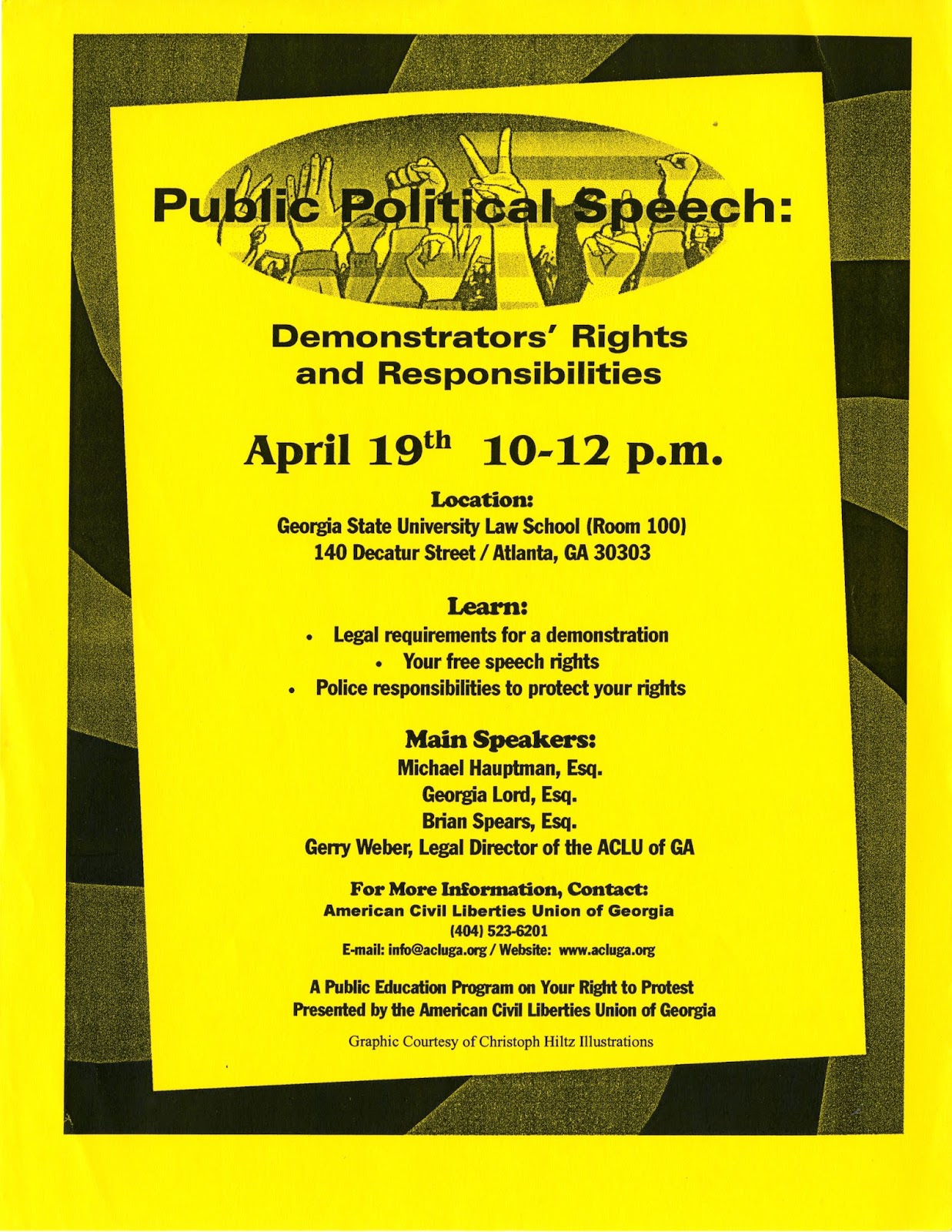
Flyer for a training program for demonstrators,
undated. Source: Series I, Box 8, Folder 50.
Each of these cases reflects the ACLU’s position that freedom of speech should be protected at all costs, lest unpopular speech and artistic or personal expression be at risk of suppression. Researchers interested in learning more about the ACLU’s position in both of these matters will find many articles and court documents regarding legal and legislative challenges to attempts to curtail free speech.


Wednesday, June 08, 2016

ACLU of Georgia: LGBT Rights

This is the first in a series of posts about the American Civil Liberties Union of Georgia Records, which were processed in 2015 and are now open for research. These records document the ACLU of Georgia's litigation, lobbying, and public education efforts to protect civil liberties for all Georgians. Their work, which began in 1963, involves issues such as freedom of speech and assembly, freedom of the press, freedom of religion, due process of law, and opposing discrimination against many groups. This series of posts was written by Shaniqua Singleton, a student at the University of Georgia's School of Law, who was instrumental in processing these papers.

Map of ACLU cases concerned with LGBT rights, 2002.
Source: Series I, Box 9, Folder 8
Last June, the U.S. Supreme Court, in a 5-4 vote, decided Obergefell v. Hodges and recognized a constitutional right for individuals identifying as lesbian, gay, bisexual, and transgender to marry. As many cities ready for their annual Pride celebration and individuals across the country reflect on the impact of Obergefell, researchers may want to review the ACLU of Georgia’s records on the history of LGBT rights litigation and legislation.

The ACLU’s records feature one of the seminal cases in LGBT rights litigation, a case that made its way to the U.S. Supreme Court and into the annals of constitutional law casebooks. That case is Bowers v. Hardwick (1982-1986). The plaintiff was arrested for violating a Georgia law that criminalized sodomy. The act in question took place in the privacy of the plaintiff’s home with a consenting male adult. After several years' worth of litigation, the U.S. Supreme Court sided against the plaintiff and ACLU and held that Georgia’s sodomy statute did not violate the fundamental rights of LGBT individuals. The decision was later overturned in Lawrence v. Texas.

ACLU staff and supporters at a demonstration for the founding
of the Lesbian and Gay Rights Project, holding a sign protesting
the Bowers v. Hardwick decision, 1987.
Source: Series 1, Box 9, Folder 9.

Researchers interested in gathering information on LGBT rights will have access to legal documents filed by the ACLU and opposing counsel in state and federal courts and a copy of the parties’ arguments before the U.S. Supreme Court. Researchers will also find several news articles, press releases, and internal ACLU memoranda covering the development of this case. Additionally, researchers will find numerous other cases in the records related to child custody, same sex marriage, free speech rights in the case Gay Guardian Newspaper v. Ohoopee Regional Library System, and many other areas of LGBT rights.

The ACLU has also been involved in advocacy for LGBT rights outside of the courtroom. For example, the records contain materials for their "Sticks and Stones" educational program to equip schools to address harassment of LGBT students and pamphlets discussing political and social developments in LGBT rights and support for organizations like the Atlanta Gay Center. Researchers interested in understanding issues of concern to the LGBT community and comparing the development of LGBT rights to more modern movements will find value in conducting research in these records.

Publication of the Atlanta Gay Center, 1988.
Source: Series I, Box 6, Folder 11.
Flyer for the "Making Schools Safe"workshop, part of the Sticks & Stones project, ca. 1999-2002. Source: Series I, Box 8, Folder 47.