Thursday, August 11, 2016

Lame Duck

In anticipation of the November 2016 presidential election, the Russell Library’s Access and Outreach staff has been working on an exhibit, On the Stump: What Does it Take to Get Elected in Georgia? opening September 2nd in the Harrison Feature Gallery. The exhibit considers the evolution of campaigning for state office and asks visitors to imagine life on the campaign trail. This post is one in a series exploring political slang and its role in elections. 

In political parlance, a lame duck is an elected official nearing the end of his or her tenure in office, especially one whose successor has been elected but not yet sworn in. Pundits often see lame ducks as holding less influence over their colleagues than those officials who will return in the following term. Yet lame ducks are often known to enact contentious policies at the proverbial eleventh hour, leaving partisan “parting shots” or “midnight regulations” for their successors to either accept or confront. Before 1976, the Georgia Constitution limited governors to a single four-year term (though governors were allowed to seek the office again after sitting out one four-year term). Essentially, then, Georgia governors were lame ducks upon their election. Today, only Virginia denies its governors the possibility of consecutive re-election.


Below: Booklet on governor's controversy published by Atlanta Journal, 1947.
 Georgia Ephemera Collection, Russell Library. 

In Georgia, lame duck status conspired with a suspect gubernatorial election in late 1946 and early 1947 to produce the so-called Three Governors Controversy.  Voters elected Eugene Talmadge, a conservative 62-year-old former governor, to succeed Gov. Ellis Arnall, a liberal up-and-comer. While Governor Arnall repealed the poll tax and uphold the Supreme Court decision ending the all-white party primary, Talmadge (as Governor from 1933 to 1937) vehemently opposed New Deal legislation he perceived as favorable to African Americans. 


Left: James V. Carmichael platform, 1946 gubernatorial campaign. Helen M. Lewis Collection of James V. Carmichael Campaign Material, Russell Library

In the Democratic primary, Talmadge defeated Jimmie Carmichael—a favor among young voters and the candidate Arnall endorsed—despite losing the popular vote to Carmichael by 16,144 votes or about 2.33% of the vote. Carmichael’s loss came at the hands of the state’s “county unit vote” system that favored candidates who controlled rural counties. However, Talmadge’s inner circle knew he was in poor health and feared he might not live to be sworn into office. Capitalizing on a loophole in the state constitution empowering the General Assembly to appoint a new governor from runner-up candidates in the event of the governor-elect’s death, the Talmadge machine quietly ran Eugene’s son Herman as a write-in candidate in the general election. With no Republican on the ballot, and fortuitous discovery of additional write-in votes from his home county, the younger Talmadge placed second with just 675 or .46% of the votes. Eugene Talmadge died on December 21, 1946.

Effective the 1946 election, the new state constitution established the office of lieutenant governor. The The “Anti-Talmadge” candidate Melvin Ernest (M. E.) Thompson had been elected to that office in November, and upon the elder Talmadge’s death, laid claim to the governorship. 

Above Right: M.E. Thompson for governor brochure, 1947. M.E. Thompson Papers, Russell Library.

On January 15, 1947, a General Assembly dominated by Talmadge-affiliated “Dixiecrats” voted to declare Herman Talmadge the next Governor. Thompson sued. Meanwhile, “lame duck” Governor Arnall refused to leave office until a successor had been” legitimately” chosen. 


Above: Herman Talmadge (center) being sworn in as Governor of Georgia, January 1947.
 Herman E. Talmadge Collection, Russell Library. 

Some two months later, the Georgia Supreme Court ruled in favor of Thompson but called for a special election to fill the remainder of the late Governor-elect Eugene Talmadge’s term (due to expire in 1951). Herman Talmadge easily defeated Thompson in that special election, held in September 1948, and did the same two years later for a full term as governor; then again in 1956 for a U.S. Senate seat that Talmadge would hold for 24 years. 

Want to find out more? Visit On the Stump on display in the Harrison Feature Gallery in the Richard B. Russell Building Special Collections Libraries  from September 2, 2016 through August 18, 2017. The Russell Library gallery is free and open to the public weekdays from 8 a.m.-5 p.m. and on Saturdays from 1-5 p.m. For more information, email russlib@uga.edu or call 706-542-5788.

Thursday, August 04, 2016

Slinging Mud

In anticipation of the November 2016 presidential election, the Russell Library’s Access and Outreach staff has been working on an exhibit, On the Stump: What Does it Take to Get Elected in Georgia? opening September 2nd in the Harrison Feature Gallery. The exhibit considers the evolution of campaigning for state office and asks visitors to imagine life on the campaign trail. This post is one in a series exploring political slang and its role in elections.

Every election cycle, voters, pundits, and candidates decry the practice of mudslinging – negative campaigning that seeks to promote one candidate only by tearing down the other. The term originates from the Latin phrase Fortiter caluniare, aliquid adhaerebit, which translates to “throw plenty of dirt and some of it will stick.” Sometime after the American Civil War, dirt was transformed into mud and the phrase became widely used in newspapers reporting on political campaign activities by the 1870s.

Leftt: Two avid supporters of political opponents battle it out! Richard B. Russell, Jr. Collection, Russell Library.

The United States has a long and rich history of mudslinging, dating at least as far back as the presidential election of 1796, in which John Adams and Thomas Jefferson each fought to succeed the venerable George Washington into the nation’s highest office. The practice continued and intensified during the 19th century, with smear campaigns aimed at candidates’ alleged political dealings (as against John Quincy Adams in 1828), views (Abraham Lincoln in 1860), or personal lives (Grover Cleveland in 1884).

Later presidential campaigns used television as a primary attack mechanism. Lyndon Johnson’s famous “Daisy” ad, though aired only once, generated widespread condemnation for insinuating that a Barry Goldwater Presidency could mean nuclear war. Johnson actually ran other ads making the Goldwater/atomic bomb link more explicit, though pundits have mostly forgotten these. A political action committee (PAC) affiliated with George H. W. Bush’s campaign in 1988 funded a now-classic “soft-on-crime” attack ad against Michael Dukakis. The most recent negative presidential ad to make the history books is probably that aired by the anti-John Kerry 527 group known as Swift Boat Veterans for Truth in 2004.

Mudslinging is not, of course, exclusively a function of campaigns for the White House. In Georgia, the 2002 U.S. Senate race is remembered as one of the nastiest races in modern memory. First-term Democratic Senator Max Cleland faced an unexpectedly strong challenge from Republican Saxby Chambliss of Moultrie.

Triple amputee Max Cleland lost both legs and an arm near in 1968 while serving in the Vietnam War. So it was especially controversial when Chambliss’ campaign aired this ad, easily the most talked-about ad of the election cycle. The ad accused Cleland of lacking “the courage to lead” President George W. Bush’s homeland security efforts and juxtaposed images of Osama bin Laden and Saddam Hussein with Cleland’s face. The final weeks showed the race closing with Cleland leading by six points in an October Mason-Dixon poll and by three points in a poll sponsored by the Atlanta Journal-Constitution.
 
Right: Governor George Ervin “Sonny” Perdue’s official portrait in 2006 with wife Mary. George Ervin (Sonny) Perdue Official Papers, Russell Library.

On Election Day, November 5, Chambliss won by a convincing 6.87% margin—a victory matched by unprecedented GOP success in state offices the same night, including the Sonny Perdue’s defeat incumbent Governor Roy Barnes, becoming the first Republican Governor in Georgia since 1868. While many Democrats attributed the win to Chambliss campaign’s mudslinging, 2002 proved to be the Georgia Republican Party’s long-awaited breakthrough after some 130 years of Democratic dominance.

Want to find out more? Visit On the Stump on display in the Harrison Feature Gallery in the Richard B. Russell Building Special Collections Libraries from September 2, 2016 through August 18, 2017. The Russell Library gallery is free and open to the public weekdays from 8 a.m.-5 p.m. and on Saturdays from 1-5 p.m. For more information, email russlib@uga.edu or call 706-542-5788.

Thursday, July 28, 2016

Riding the Coattails

In anticipation of the November 2016 presidential election, the Russell Library’s Access and Outreach staff has been working on curating an exhibit, On the Stump: What Does it Take to Get Elected in Georgia? opening September 2nd in the Russell Library’s Harrison Feature Gallery. The exhibit On the Stump considers the evolution of campaigning for state office and asks visitors to imagine life on the campaign trail. This post is one in a series exploring political slang and its role in elections.

In electoral politics, constituents have a tendency to vote according to party. In the nineteenth century, voters simply choose a party ballot that encouraged “riding on the coattails.”  Though modern voting machines decreased “straight-ticket voting,” the trend still exists. Popular presidential candidates , for instance, often attract votes to Congressional candidates of the same party. Dubbed the coattail effect, political analysts continue to debate its significance in shaping electoral outcomes.

Right: Marion Baker and Timmy O'Keefe campaigning for Herman Talmadge, Savannah, GA, 1980.  Herman E. Talmadge Collection, Russell Library.

The 1980 election gives us the most convincing example of presidential coattails in modern history. Republican Ronald Reagan ousted incumbent President Jimmy Carter by a wide popular vote margin of 50.7 percent to 41 percent. The GOP gained 34 House seats (considerably narrowing the Democrats’ majority) and a stunning 12 Senate seats, moving that chamber from a 58-41 Democratic majority to a 53-46 Republican one, effectively ending Democratic  Party’s 26 year reign over the “world’s greatest deliberative body.”


Left: Mack Mattingly meeting with constituents on the campaign trail, 1980. Mack F. Mattingly Papers, Russell Library. 

Few states that year produced more significant results than Georgia. Despite native son Jimmy Carter securing 56 percent of the popular vote in the presidential election, four-term incumbent Democratic Senator Herman Talmadge lost a close 51-to-49 race to state Republican Party chairman Mack Mattingly. Mattingly’s victory, by about 27,500 votes and a 1.7 percent margin, was the first for a Republican Senate candidate in Georgia since Reconstruction and the first since the 17th Amendment created popular elections for the U.S. Senate.


Above: Talmadge Campaign Leaflet, 1980 re-election campaign.
 Herman E. Talmadge Collection, Russell Library.  

A number of factors led to Talmadge's defeat—among them his known battle with alcoholism, and allegations of financial misconduct which landed him before the Senate Ethics Committee in 1979. In the Democratic primary, Zell Miller offered a strong challenge to the weakened Talmadge campaign, which never recovered for the November general election. In a year dominated by Republican victories, it is difficult to say what might have happened had Talmadge not faced scandal and personal difficulties during the campaign. Republican Mack Mattingly served in the U.S. Senate only one term, losing to Democrat Wyche Fowler in 1986.
To find out more about the ins and outs of the 1980 Senatorial campaign between Talmadge and Mattingly, take a look through their finding aids online. Scrapbooks (available on microfilm) from the Mattingly collection, compiled by the senator's staff and family, record the highlights of the senator's political career and campaigns. The Talmadge Political Series documents all his political campaigns from 1956-1980.

More recently, President Obama’s solid victory in 2008 accompanied impressive Democratic wins for Democrats in Congress, gaining eight seats in the Senate (for a 59-41 majority, the widest for either party since the 1970s) and 21 in the House (for a 257-178 majority, the widest since 1992). However, congressional results in 2008 may have simply represented a welcoming year for the Democratic Party, both “up” and “down” the ballot, rather than evidencing far-flung Obama coattails.

What will the presidential election of 2016 hold? Stay tuned…..

Want to find out more? Visit On the Stump on display in the Harrison Feature Gallery in the Richard B. Russell Building Special Collections Libraries  from September 2August 22, 2016 through July 31August 18, 2017. The Russell Library gallery is free and open to the public weekdays from 8 a.m.-5 p.m. and on Saturdays from 1-5 p.m. For more information, email russlib@uga.edu or call 706-542-5788.

Thursday, July 14, 2016

ACLU of Georgia: Freedom of Speech and Expression

This is the second in a series of posts about the American Civil Liberties Union of Georgia Records, which were processed in 2015 and are now open for research. These records document the ACLU of Georgia's litigation, lobbying, and public education efforts to protect civil liberties for all Georgians. Their work, which began in 1963, involves issues such as freedom of speech and assembly, freedom of the press, freedom of religion, due process of law, and opposing discrimination against many groups. This series of posts was written by Shaniqua Singleton, a student at the UGA School of Law, who was instrumental in processing these papers.

Sticker from the ACLU's "Keep America Safe and Free"
campaign to defend individual freedom in the wake of
September 11 and arguments related to national
security, 2002. Source: Series I, Box 8, Folder 48.
In an election year it is not uncommon to hear candidates discuss issues like gun control, foreign policy, and taxation. However, this election year has had a distinct flavor about it: increasingly, the conversation has focused not on social and fiscal policy, but rather on the free speech rights of candidates and the individuals who attend their events. For several years, the ACLU of Georgia has worked to shape case law and legislation that aims to protect the First Amendment rights of all segments of our population, even when that speech is unpopular or inflammatory.

For example, the ACLU of Georgia’s records contain a number of issue files and legislative efforts to protect free speech rights. The ACLU was heavily involved in a legislative campaign and case (Maher v. Avondale Estates) challenging a DeKalb County ban on political signs in residential areas. Researchers will find legal documents highlighting the ACLU’s constitutional challenge to this ordinance, as well as newspaper articles covering the litigation and legislative efforts to combat laws of this nature. Similarly, the ACLU has been involved in efforts to protect whistleblowers from SLAPP lawsuits (Atlanta Humane Society v. Harkins), the free speech rights of the KKK, free speech rights at university's (Schmitt v. Fort Valley State - 2002-2006), and defending the rights of students to wear confederate flags (Schingler v. Seminole County School District).

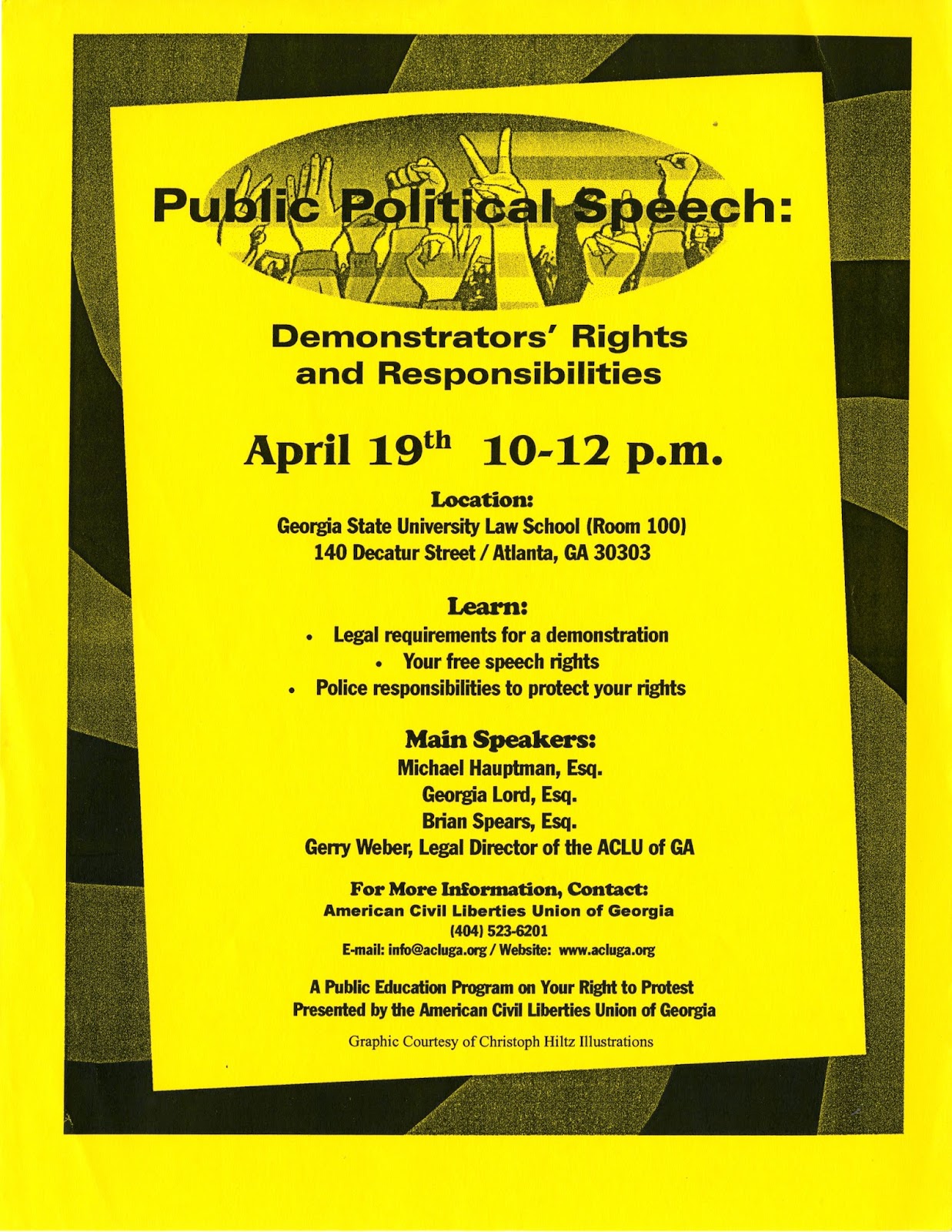
Flyer for a training program for demonstrators,
undated. Source: Series I, Box 8, Folder 50.
Each of these cases reflects the ACLU’s position that freedom of speech should be protected at all costs, lest unpopular speech and artistic or personal expression be at risk of suppression. Researchers interested in learning more about the ACLU’s position in both of these matters will find many articles and court documents regarding legal and legislative challenges to attempts to curtail free speech.


Wednesday, June 08, 2016

ACLU of Georgia: LGBT Rights

This is the first in a series of posts about the American Civil Liberties Union of Georgia Records, which were processed in 2015 and are now open for research. These records document the ACLU of Georgia's litigation, lobbying, and public education efforts to protect civil liberties for all Georgians. Their work, which began in 1963, involves issues such as freedom of speech and assembly, freedom of the press, freedom of religion, due process of law, and opposing discrimination against many groups. This series of posts was written by Shaniqua Singleton, a student at the University of Georgia's School of Law, who was instrumental in processing these papers.

Map of ACLU cases concerned with LGBT rights, 2002.
Source: Series I, Box 9, Folder 8
Last June, the U.S. Supreme Court, in a 5-4 vote, decided Obergefell v. Hodges and recognized a constitutional right for individuals identifying as lesbian, gay, bisexual, and transgender to marry. As many cities ready for their annual Pride celebration and individuals across the country reflect on the impact of Obergefell, researchers may want to review the ACLU of Georgia’s records on the history of LGBT rights litigation and legislation.

The ACLU’s records feature one of the seminal cases in LGBT rights litigation, a case that made its way to the U.S. Supreme Court and into the annals of constitutional law casebooks. That case is Bowers v. Hardwick (1982-1986). The plaintiff was arrested for violating a Georgia law that criminalized sodomy. The act in question took place in the privacy of the plaintiff’s home with a consenting male adult. After several years' worth of litigation, the U.S. Supreme Court sided against the plaintiff and ACLU and held that Georgia’s sodomy statute did not violate the fundamental rights of LGBT individuals. The decision was later overturned in Lawrence v. Texas.

ACLU staff and supporters at a demonstration for the founding
of the Lesbian and Gay Rights Project, holding a sign protesting
the Bowers v. Hardwick decision, 1987.
Source: Series 1, Box 9, Folder 9.

Researchers interested in gathering information on LGBT rights will have access to legal documents filed by the ACLU and opposing counsel in state and federal courts and a copy of the parties’ arguments before the U.S. Supreme Court. Researchers will also find several news articles, press releases, and internal ACLU memoranda covering the development of this case. Additionally, researchers will find numerous other cases in the records related to child custody, same sex marriage, free speech rights in the case Gay Guardian Newspaper v. Ohoopee Regional Library System, and many other areas of LGBT rights.

The ACLU has also been involved in advocacy for LGBT rights outside of the courtroom. For example, the records contain materials for their "Sticks and Stones" educational program to equip schools to address harassment of LGBT students and pamphlets discussing political and social developments in LGBT rights and support for organizations like the Atlanta Gay Center. Researchers interested in understanding issues of concern to the LGBT community and comparing the development of LGBT rights to more modern movements will find value in conducting research in these records.

Publication of the Atlanta Gay Center, 1988.
Source: Series I, Box 6, Folder 11.
Flyer for the "Making Schools Safe"workshop, part of the Sticks & Stones project, ca. 1999-2002. Source: Series I, Box 8, Folder 47.

Friday, April 08, 2016

Open for Research: New Collections Available Now

The Russell Library is pleased to announce the opening of 10 new collections. These diverse collections include material for researching:

The protection of civil liberties and the legal, social and cultural impact
The 1946 Moore’s Ford Lynching and its investigation
The role of Georgia agriculture in influencing state and national policy
The importance of travel and tourism to Georgia’s economic development
Issues important to Georgians during the Civil Rights and Vietnam War eras
Gubernatorial politics in the 1950s and 1960s
Community engagement in small-town Georgia

To explore these subjects and more, see the descriptions below and follow the links for complete collection guides.

American Civil Liberties Union of Georgia Records, 1938-2014 (bulk, 1975-2000)
The American Civil Liberties Union (ACLU) of Georgia is a nonprofit corporation founded in 1963 that is focused on protecting civil liberties in the state of Georgia. The records document their litigation and lobbying work, the subjects that they are concerned with, and their daily operations and include correspondence, case files, research files, and publications. Common subjects include the criminal justice system, freedom of religion, freedom of speech and assembly, LGBT rights, open government, racial discrimination, and student and juvenile rights.

D.W. Brooks Papers, 1900- 1999 (bulk, 1950-1990)
D. W. Brooks (1901-1999) was a farmer and cooperative executive, running the Cotton Producers Association (later renamed Gold Kist) as well as insurance companies for farmers. His papers document his businesses and Georgia agriculture, as well as his service to the U.S. government, several universities, and the Methodist Church. The papers include correspondence, business and committee reports, meeting materials, and subject files.

J. Phil Campbell, Sr. Papers, 1908-1944 (bulk, 1940-1944)
The J. Phil Campbell, Sr. Papers document his work with the U.S. Department of Agriculture and include correspondence, materials related to the National Honors Extension Fraternity Epsilon Sigma Phi, reports about soil conservation, histories that Campbell wrote about the USDA, and clippings about his life and career.

Glenn W. (Jack) Ellard Papers, 1921-2001 (bulk, 1970-1991)
Glenn W. (Jack) Ellard (1912-2001) served as Clerk of the Georgia House of Representatives (1959-1991). His papers document his career, World War II service, and family, and include correspondence, clippings, photographs, scrapbooks, awards, and militaria.

Myles Godfrey Collection of Georgia Political Materials, 1945-1984
The Myles Godfrey Collection of Georgia Political Materials includes photographs, ephemera and correspondence related to Georgia Governor Eugene Talmadge, U.S. Senators Richard B. Russell and Herman Talmadge, and Max Cleland as Georgia Secretary of State.

Marvin Griffin Papers, 1946-1982 (bulk, 1954-1962)
Marvin Griffin (1907-1982) served as Lieutenant Governor and Governor of the State of Georgia (1948-1955; 1955-1959). His papers include speeches, campaign files, clippings, correspondence, photographs, and audiovisual materials.

Bill T. Hardman, Sr. Papers, 1960-2009 (bulk, 1961-1970)
Bill T. Hardman, Sr. (1926-2013) served as Georgia's first tourism director (1959-1970). His papers document his work to promote Georgia tourism throughout the United States and abroad and include news clippings, photographs, scrapbooks and printed material.

Samuel J. Hardman Research Files on the FBI Investigation of the Moore's Ford Lynching, 1946-2015 (bulk, 1946-1947)
The Samuel J. Hardman Research Files on the FBI Investigation of the Moore's Ford Lynching includes researcher Hardman's redacted copies of FBI documents related to the investigation (1946-1947). Also included are files related to the 1991 reopening of the case as well as Hardman’s article about the lynching.

S. Fletcher Thompson Papers, 1967-1971
S. Fletcher Thompson served as a U.S. Representative (1967-1973) and as a Georgia State Senator (1965-1967). His papers document his congressional career, including material related to the Vietnam War, the Civil Rights Era, and Republican Party politics.

Winterville Marigold Festival Records, 1971-2015
The Winterville Marigold Festival is an annual event held in Winterville, Clarke County, Georgia that started in 1971 to celebrate the community and raise funds for city improvement projects. The records consist of planning documents, promotional materials, scrapbooks, photographs, T-Shirts, posters, and digital files.

Friday, April 01, 2016

UGA Special Collections Libraries to Host Spring Exhibits Reception

The Richard B. Russell Building Special Collections Libraries at the University of Georgia will host its bi-annual reception celebrating new exhibitions April 14 at 5:30 p.m. The event will include live music from local band Hog-Eyed Man; a custom print station operated by Double Dutch Press; light refreshments and gallery tours. The reception is free and open to the public.

RSVP to lnessel@uga.edu or call 706.542.3879. For more information about the Special Collections Libraries call 706.542.7123 or visit www.libs.uga.edu/scl 

Exhibitions highlighted include:

“The Greatest Bulldog of Them All: Dan McGill,” examines the legacy of the longtime UGA tennis coach, sports information director and creator of the Bulldog clubs. Included in the display are materials donated to the Hargrett Rare and Manuscript Library by Magill’s family, and materials loaned to the Hargrett Library by the ITA Tennis Hall of Fame Museum. Tennis rackets, rarely seen photographs, and ephemera from a life dedicated to the service of the University of Georgia make up the exhibit.

“Seeing Georgia: Changing Visions of Tourism in the Modern South,” explores the state’s transformation from a way station along the route to Florida into a tourist destination all its own. The exhibit highlights six popular sites in Georgia and considers questions of access, preservation, and economics. A replica roadside stand, 1920s gas pump, as well as historic photographs, postcards, and other ephemera set the scene and invite visitors to explore the tourist experience over the course of the 20th century.

“Selections from the Georgia Disability History Archive,” highlights the establishment of the Georgia Disability History Archive at the Richard Russell Library for Political Research and Studies. A powerful collection of artifacts, documents, and ephemera tell the story of disability advocacy in Georgia. Topics addressed include initiatives for education and awareness to end employment discrimination; housing and transportation accessibility; and challenges facing disabled veterans attempting to receive adequate support and healthcare.

“John Abbot, Early Georgia’s Naturalist Artist,” showcases the works of an Englishman who arrived in Georgia in 1776, hoping to jump-start a career as a natural history illustrator. Abbot intended to return to London after he had made enough drawings to establish his career. Instead he remained in rural Georgia, where he continued to collect and draw insects and birds into his 80s, producing more than 7,000 watercolor drawings. The display includes watercolor illustrations from the Hargrett Rare Book and Manuscript collections, along with drawings on loan from other institutions. The exhibit celebrates the 20th anniversary of the James W. Woodruff, Sr. Center for the Natural History of Georgia.

"Celebrating 75 years of excellence: The George Foster Peabody Awards" looks at the origins and evolution of this most prestigious Georgia institution through founding documents and highlights from the Peabody Awards Collection.

"Olympic Legacy" celebrates the 1996 Olympics, spotlighting events in Athens as well as Atlanta. The exhibit combines materials from the Hargrett Rare Book and Manuscripts Library, the Richard B. Russell Library for Political Research and Studies, and the Walter J. Brown Media Archives and Peabody Awards Collection to explore the lasting impact of this international celebration on Georgia today.


Wednesday, March 16, 2016

New Digital Files Now Available

The Russell Library is pleased to announce the opening of digital files from thirteen collections related to Georgia politicians, including the papers of 2 Senators, 3 Congressman, 3 State Legislators, and 3 Georgia Governors.  These files can be requested from the finding aid and are shared with the researcher through Google Drive. You do not have to come to the library in order to view these files.

U.S. Senate

Mack Mattingly served in the U.S. Senate from 1981 to 1987. The digital files include slides about his involvement with the Conservation Trust of Puerto Rico, a clip from him talking about Savannah's ports on the TV show Mid-Morning Live, and short writings by his wife Carolyn Mattingly about their travels.

Max Cleland served in the U.S. Senate from 1997 to 2002. The digital files include constituent mail, committee files, subject files on legislation, press files (including copies of his website), campaign materials, and photographs.

An article adapted from a talk that McLeod gave at the Russell Library 40th Anniversary Symposium entitled "My Time in the Senate" about McLeod's experiences with Herman Talmadge and Hubert Humphrey on the Senate Agricultural Committee during the 1970s.

U.S. House of Representatives

Don Johnson served in the U.S. House of Representatives from 1993 to 1995. The digital files include three chapters of an autobiography which focus on his service in Congress.

Charles Norwood served in the U.S. House of Representatives from 1995 to 2002. The digital files are mostly press files, including articles about current events, press releases, and columns and speeches.  They also include a digital newsletter sent to constituents while he was campaigning.

Buddy Darden served in the U.S. House of Representatives from 1983 to 1995. The digital files include constituent mail, subject files on legislation, press files (including speeches and a newsletter), and campaign materials. 

Georgia State Legislature

Eric Johnson served in the Georgia Senate from 1994 to 2009. The digital files include email with constituents, files on legislation (especially a bill he proposed about holding owners accountable for abandoned sunken boats on the coast of Georgia), press releases, speeches, and photographs.

John C. Foster served in the Georgia Senate from 1975 to 1993. The digital file is an auditing spreadsheet related to his committee work.

M. Louise McBee served in the Georgia House of Representatives from 1991 to 1994. The digital file is a report of the Hope Scholarship Joint Study Commission.

Georgia Governors

Carl E. Sanders was governor of Georgia from 1963 to 1967. The digital files are photographs and include images from airport dedications, the Southern Governors' Conference, flying on an Air Force plane, and a film crew for a movie starring Susan Hayward.

Ed Friend was a photographer for Georgia Governors Marvin Griffin, Herman Talmadge, Ernest Vandiver, and Carl Sanders. The digital files are scans of photographs, scrapbook pages and articles, and also include his recorded memoirs.

Perdue was Governor of Georgia from 2003 to 2011. Most of the digital files are published materials (press releases, speeches, proclamations, executive orders) and photographs. The files also include some subject files and files of the legal division.


Zell Miller served as Lieutenant Governor of Georgia from 1975 to 1991, Georgia Governor from 1991 to 1999, and U.S. Senator from 2000-2005. The digital files include press releases, preparation for press conference, and text for speeches given when Miller was governor.

Tuesday, January 26, 2016

Campus and Community Partners to Host 2nd Annual School Lunch Challenge


Local chefs will once again take on the School Lunch Challenge March 19, creating tasty dishes that meet USDA requirements for the National School Lunch Program. Attendees will have a chance to sample the creations at the cooking competition from 12-1:30 p.m. in the cafeteria of Whitehead Road Elementary School.

Building on increased interest in the National School Lunch Program, and inspired by the 2014 exhibition, Food, Power, Politics: The Story of School Lunch, the Richard B. Russell Library for Political Research and Studies and others partnered in 2015 to host a fun, educational event to engage the Athens community with the past, present, and future of school lunch. “Richard Russell co-sponsored the legislation which created the National School Lunch Program in 1948. We are glad to host this event that draws attention to the NSLP today, and our planning team is excited to make this an annual happening in Athens,” said organizer Jan Hebbard, outreach archivist at the Russell Library.

The 2016 event will expand attendance from 150 to 200 people, and offer hands-on activities and cooking demonstrations, in addition to the cooking competition. Local chef Hugh Acheson will serve as the master of ceremonies. Acheson recently launched Seed Life Skills, a non-profit committed to revamping Family and Consumer Science curriculum, supporting education that teaches skills including hands-on culinary instruction, conscious consumer economics, and D.I.Y. design principles.
Attendees at the 2015 School Lunch Challenge
enjoying samples from the cooking competition. 
Once again, the centerpiece of this event will be a cooking competition which invites participating teams, drawn from local restaurants and advised by members of the Clarke County School District (CCSD), to create dishes in accordance with USDA guidelines for the National School Lunch Program. A panel of student judges drawn from CCSD schools will vote to determine an overall winner. The winning team’s plate will be incorporated into the CCSD school lunch menu during the 2016-2017 school year.

Last year’s student judges voted The National the overall winner. Led by Chef Emmanuel Stone, the team won over judges with a deluxe chicken burrito and a side of broccoli with cheese. Adapted into a burrito bowl to reduce preparation time, this recipe debuted on the CCSD School Lunch Menu on Nov. 1 to rave reviews. The National team returns this year to defend their title against new competitors Pulaski Heights BBQ, The Pine, and a team made up of FACS teachers from the Clarke County School District.
This event is free and open to the public but attendance will be capped at 200 people. Tickets are available beginning February 26 through the Eventbrite website. Attendees are encouraged to bring donation items to benefit the Food 2 Kids program operated by the Foodbank of Northeast Georgia. Requested items include beans-n-franks (pop-top cans) and jars of peanut butter.   

The event is free and open to the public but attendance will be capped at 200 people. Tickets are available beginning February 26 through the Eventbrite website.

The 2016 School Lunch Challenge is sponsored by the Richard B. Russell Library for Political Research and Studies, the Clarke County School District, the Athens Land Trust, Athens Farm to School, UGA’s College of Family and Consumer Sciences and Department of Foods and Nutrition, The Fresh MarketSeed Life Skills, and Heirloom Cafe and Fresh Market.  


For more information, contact Jan Hebbard at jhebbard@uga.edu or (706) 542-5788.

Friday, January 08, 2016

Community Forum, What Kind of Government Should We Have?

When: Wednesday, March 2, 2016 3:30 p.m. - 5:00 p.m.

Where:
 Room 258, Richard B. Russell Building Special Collections Libraries

What:
Community Forum, A New Land: What Kind of Government Should We Have?

It is the spring of 1787. We are now in a critical period. Our new republic is unstable and the liberty we won just four years ago is threatened. We’ve lost the unity inspired by our fight against Britain. Trade is difficult and our physical safety is uncertain. There are conflicts within and threats from without. What should we do? How will we survive? How can our hard-won liberty be sustained? The questions boil down to this: What kind of government should we have?

Please join the Russell Forum for Civic Life and Reacting to the Past at the University of Georgia on Wednesday, March 2 from 3:30-5:00 p.m. for a community forum considering key questions of this historical period. The discussion will take place in the large event space (room 285) of the Richard B. Russell Building Special Collections Libraries. With the help of trained neutral moderators, participants will weigh and discuss three options for deliberation.

This issue guide is a part of the National Issues Forums' Historic Decisions series. Most guides published by the National Issues Forums Institute seek to stimulate deliberation by diverse groups of citizens about current public problems. This one focuses on a time in the past: 1787, just before the Constitution was written, negotiated, and adopted at the Constitutional Convention. All of the actions proposed in this issue book are based on ideas or proposals that were being considered in 1787. But these ideas were generated in a society in which many Americans were excluded from public discussions and democratic governance. Deliberative forums based on this issue guide will be more effective if they include diverse perspectives, including ones that were not heard in 1787.

The event is free and all ideas are welcome.  Registration for the event is not required, but participants may request a copy of the forum discussion guide in advance by emailing russlib@uga.edu. For more information call (706) 542-5788.